Within reach · never been
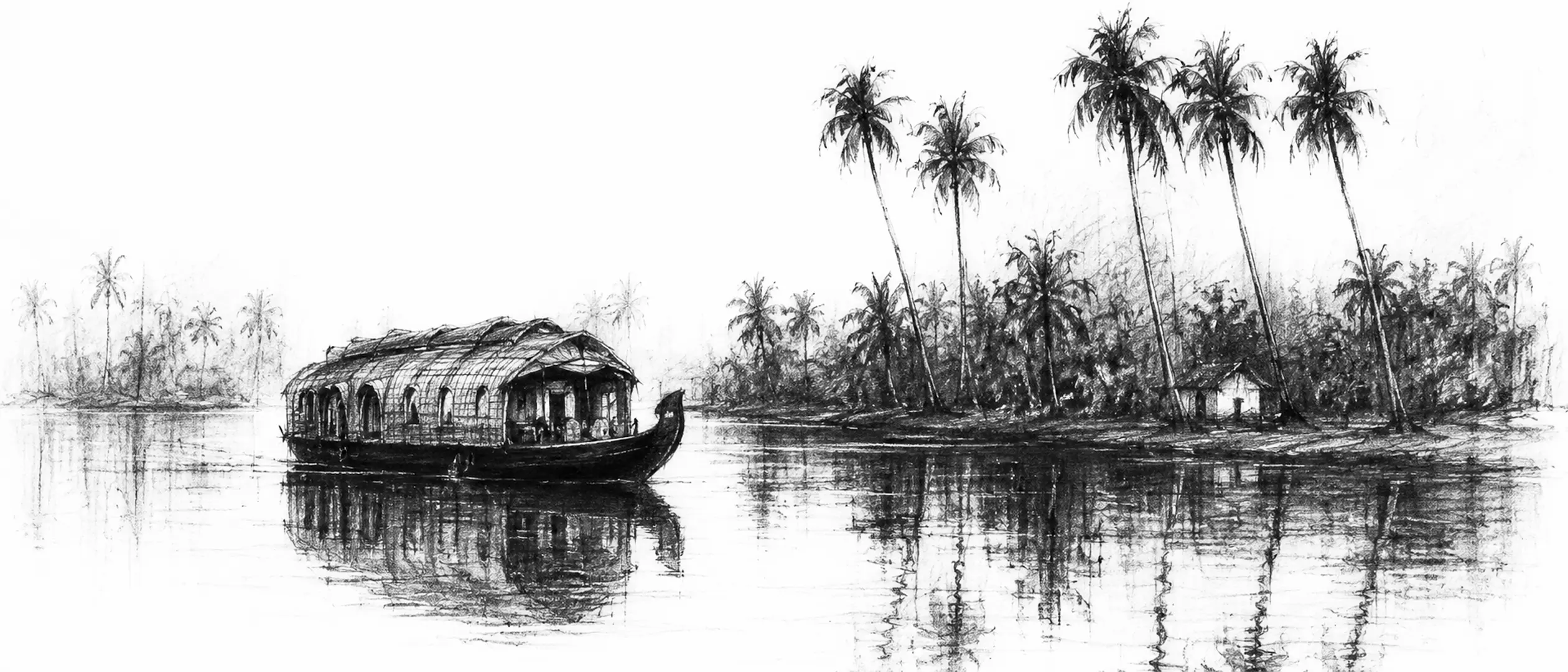
I have never floated on the water country of Alleppey, though it is part of my own country and a night’s journey south of places I have actually stood in. Down in the green south-west, where the land has barely decided to be land at all, the coast frays into a vast loose net of lagoons and lakes and canals, miles of still fresh water threaded through palm and paddy. The ordinary business of life in Alleppey happens afloat. People go to school by boat, to market by boat, to church by boat, and carry their rice and their fish and their gossip along water-lanes the way the rest of us use streets. Alleppey sits in the middle of all that water. I have only ever seen Alleppey lying still in other people’s photographs.
I will not call it by the borrowed name everyone uses, the one that lends it another city’s canals. I have spent that name already, on the actual city it belongs to, and this place deserves better than to be a comparison. It is not a smaller, warmer version of anywhere. It is its own strange thing, a country where the proportions of land and water are reversed from everywhere I have lived, where the water is the solid fact and the land the thin uncertain margin. Most astonishing to me, they grow their rice in fields that lie below the level of the water around them, the whole crop kept alive behind low banks, farming carried on at the bottom of a shallow sea.
The slow houseboats of Alleppey
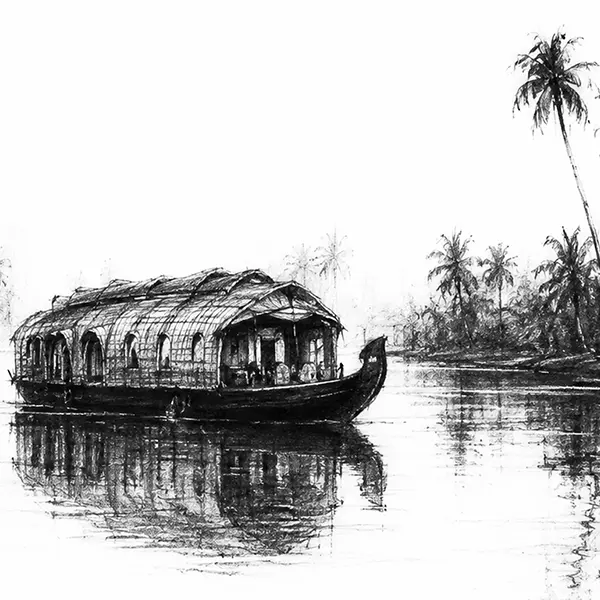
The houseboats are the famous thing now, and they are the picture that first hooked me. Great slow barges with curved roofs of woven palm-thatch, like floating haystacks, drifting across the open lagoons at the pace of a walking man. They began as rice barges and turned, somewhere along the way, into a way of living slowly on the water for a day or two, a bedroom and a kitchen and a little deck, poled and puttered through the channels and tied to a palm at night. I have looked at them on screens until I could draw one from memory. A night spent on water that does not move, under a thatched roof, with the whole green country sliding past, is one of the most purely peaceful things I can imagine. I have never once untied the rope.
The stillness that becomes a mirror
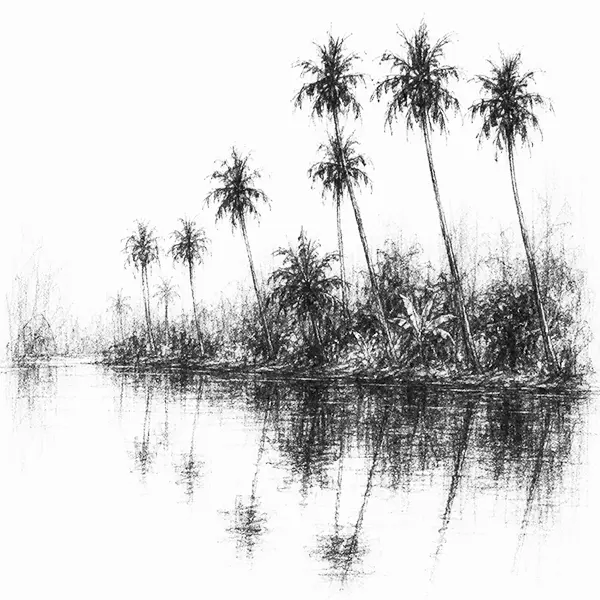
What the photographs all carry, whoever takes them, is the stillness — water so flat at evening that it stops being water and becomes a mirror, the palms along the bank standing on their own reflections, the sky laid out twice, a doubled green world hung around a seam you can barely find. I have lived my whole life beside moving, working, crowded water — rivers in a hurry, a sea with surf, the monsoon coming down in ropes. The notion of water that simply lies there, perfectly still, holding the trees upside down without a ripple, is exotic to me in a way no foreign skyline is. I want to sit at the front of one of those boats at dusk and not be able to tell, for a moment, which way is up.
The narrow boats and the working day
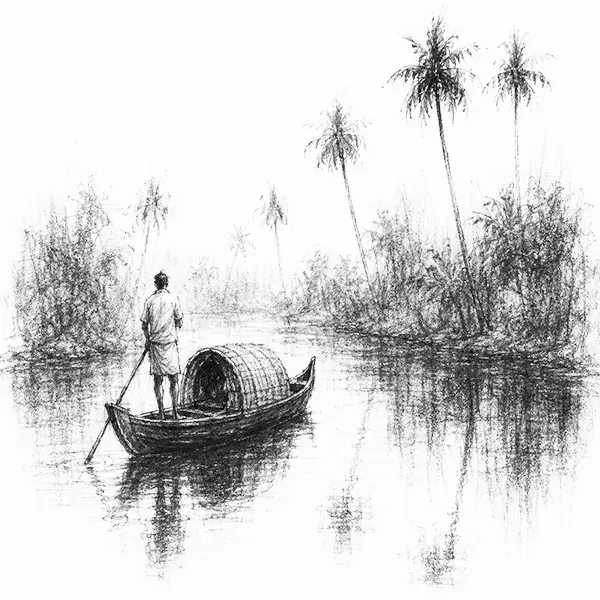
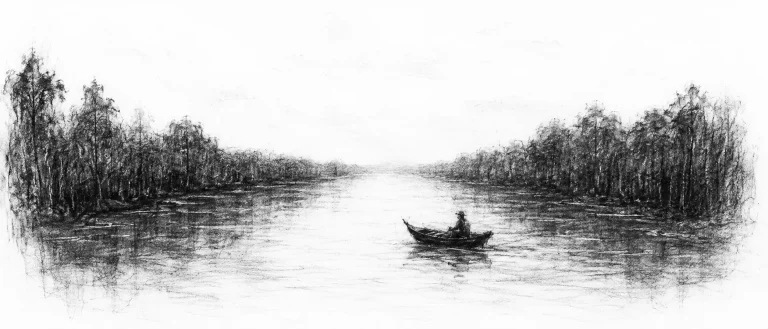
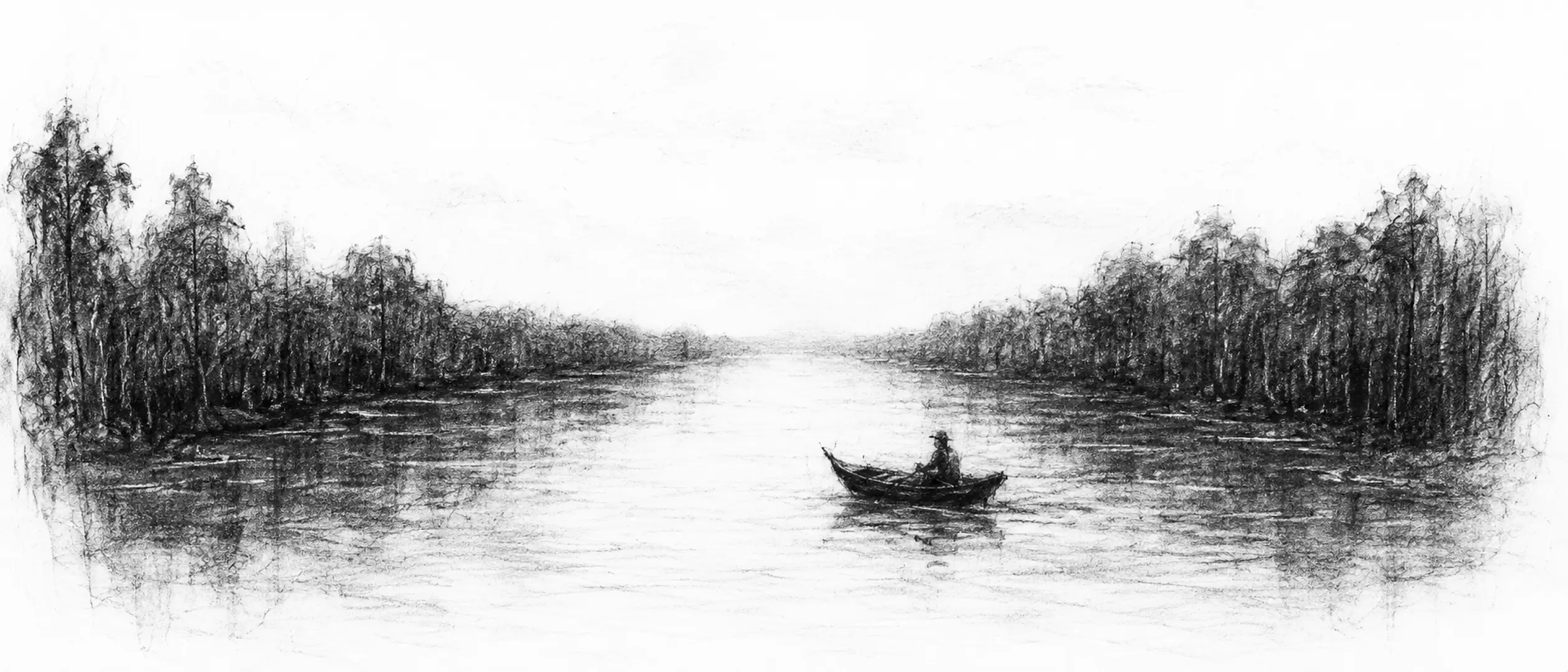
But it is not the tourist barges I think about most; it is the ordinary boats, the small narrow country canoes that do the real work, poled and paddled along the tighter green canals where the houseboats cannot go. That is where the actual life is — a man standing in the stern working a long pole, a few sacks or a bundle of thatch or a single passenger aboard, sliding past doorsteps that open straight onto the water, past women washing at the canal edge and children watching from the bank. I am drawn far more to that than to the holiday version: the place not as a thing to be cruised through but as a place where people live their whole unremarkable days on and beside the water, and have forever.
Once a year, the water roars
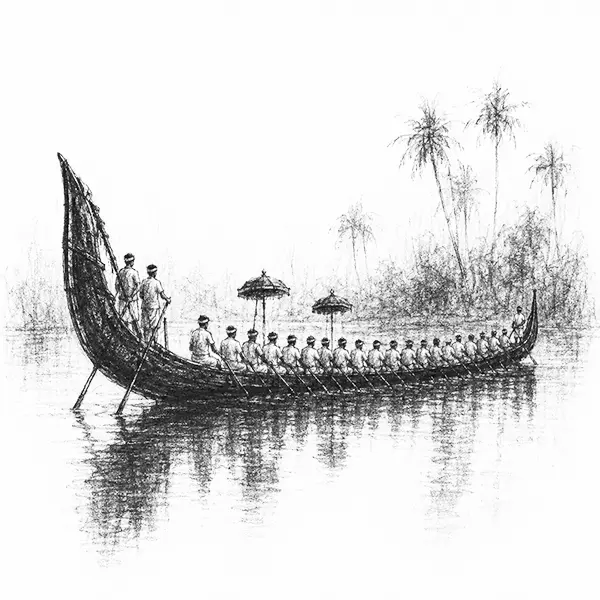
And once a year the still water at Alleppey is not still at all. The snake-boats come out — immense slender canoes, the longest rowed boats anywhere, their sterns reared up high and curved like the raised head of a cobra, crewed by a hundred men or more rowing in furious unison to a drum and a song, throwing the whole lagoon into white water as villages race villages down the channels and the banks go mad. I have watched it only on television, the long black hulls flashing past, the oars hitting the water as one. It is the opposite of everything else I love about the place, all noise and muscle and speed where the rest is hush, and I would give a good deal to stand on a packed bank one monsoon afternoon and feel the drum of it come up through the ground.
How a landscape feeds itself
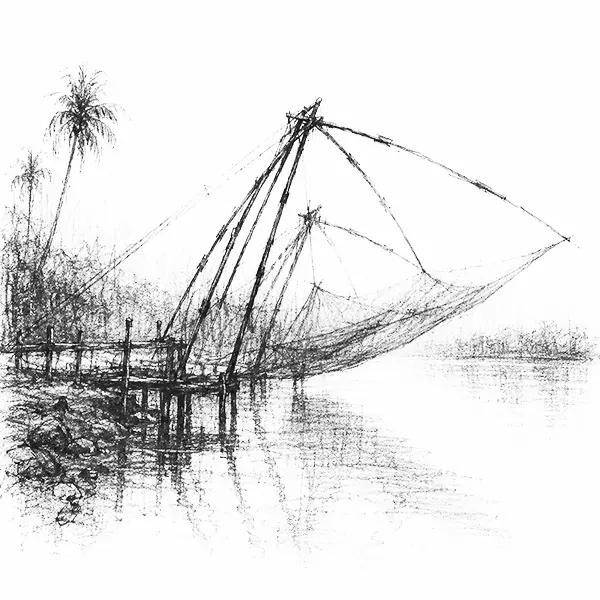
There is fish in all that water, of course, and an old patient apparatus for taking it — big shore-nets slung from leaning wooden frames at the edges of the channels, lowered and lifted on their cantilevers, standing along the banks at evening like the bare ribs of something, black against the last of the light. They belong to the working face of the place, the one that exists whether or not anyone comes to photograph it, and I find I trust a landscape more when I can see how it feeds itself. I would rather watch a net come up empty at dusk than do almost any of the things one is supposed to go there to do.
Rice in Alleppey, grown below the sea
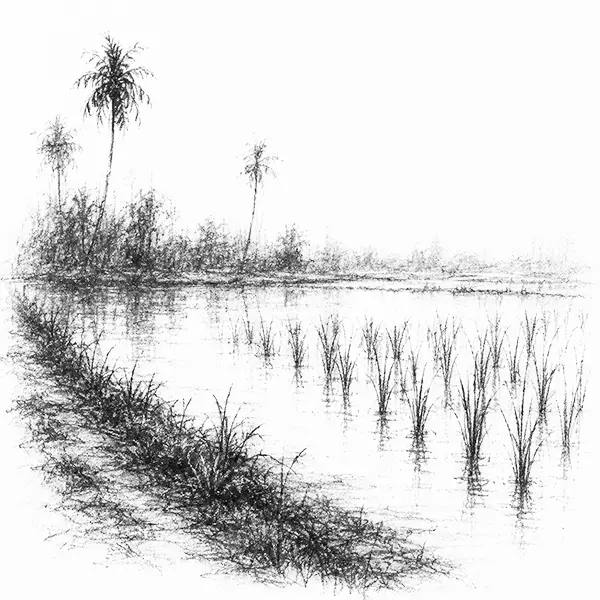
And under it all, the paddy — the impossible fields, vivid green, stretching flat to the palms, lying lower than the water that surrounds them, kept dry behind their thin earthen banks by nothing more than nerve and an old understanding with the water. It is the detail that tells me the place is genuinely unlike anywhere I know: a whole agriculture conducted below the waterline, a people who long ago made a bargain with a flood and have been quietly keeping their side of it ever since, raising the most ordinary crop in the world in the least ordinary way. I would like to walk one of those narrow banks with water on both sides, level with my knees, and understand how anyone ever dared.
So here is the familiar ending, worn smooth by now from use. There is no ocean to cross to get there — only an ocean of the wrong kind, the inland sort, that I have somehow never reached. It is a night south by train, the same length of journey people make for a wedding without thinking. I have stood on the Kerala coast, felt that warm green air, eaten that food; I got that close and turned for home before the land turned to water. A man who has spent his whole life beside water, who loves it in all its moods, who could be poled through a hundred miles of it tomorrow if he simply went — and who keeps not going, and keeps the whole still mirrored country folded up in other people’s photographs, dry, on the wrong side of a journey he has never quite begun. A man who has never been abroad, stopped at the last by an ocean that was never even the sea.
“Alappuzha (Alleppey): town on the Kerala coast at the heart of the backwaters, a network of brackish lagoons, lakes and canals running parallel to the Arabian Sea; noted for its houseboats, its low-lying paddy fields cultivated below sea level, and its annual snake-boat races.”
— from the one-volume encyclopedia I have had since school

Leave a Reply