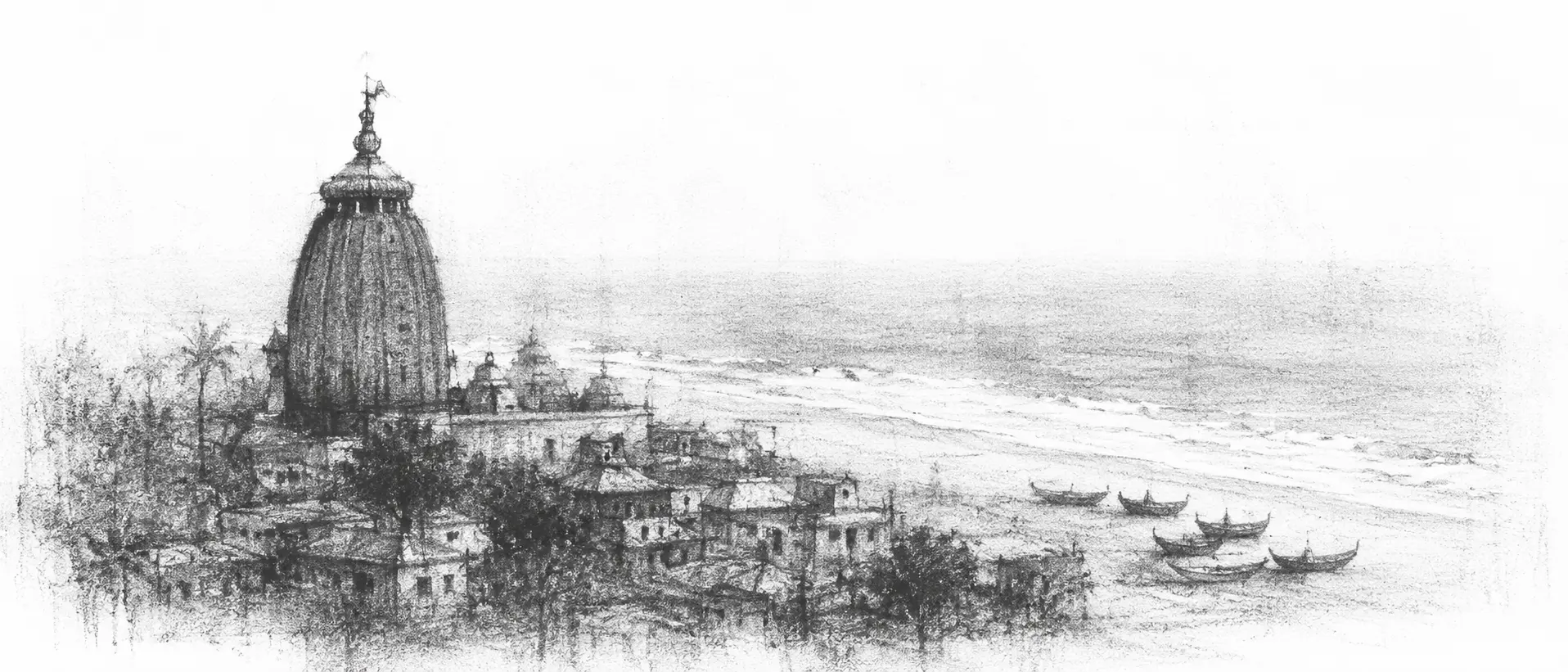
Within reach · never been
I have never been to Puri, the great pilgrimage town on the east coast that nearly everyone I grew up among has been to, a single night’s train down the shore from where I was born. One of the holiest temples in the land stands there almost within sound of the sea, and my own people go, generation after generation, for their faith and their holidays both, packing the trains down the coast every season. Puri is not far. It is the most ordinary near place imaginable, the default journey, the one half of my region seems to make as a matter of course. And I, who grew up a night’s train away, in the very heartland of the people who go there, have never once gone.
That is the particular sting of this one. Puri is not exotic and it is not difficult. If anything it is the opposite, so familiar a destination, so completely the expected thing, that to admit I have never been is to admit a small but genuine oddity in my life. Everyone goes to Puri. The sea there, the temple there, the sweets there, are woven so deep into the imagination of my part of the country that I half feel I have been, that I am remembering rather than dreaming. But I am dreaming. I have built the whole place out of other people’s returns from it, out of the photographs and the stories and the small carved souvenirs that came back, and never out of my own feet on its sand.
I have it, then, the way I have all these near places: the encyclopedia, documentaries, photographs, and above all the endless secondhand account of a place that the people around me treat as practically an extension of home. Between them they have built me a town of one enormous temple and one wide grey sea, of pilgrims and fishermen and crowds, of salt air and conch shells and chariot wheels. I have never stood on that particular beach with that particular spire at my back. It is the strangest gap in the near room, the close thing that everyone but me has closed.
At the gate of Puri temple
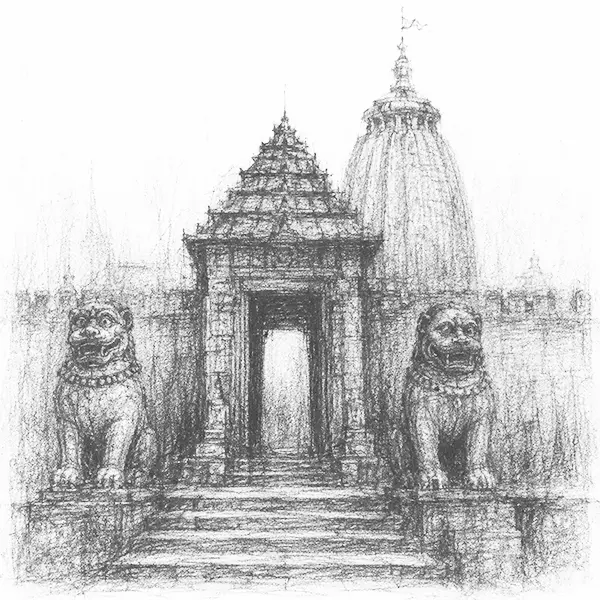
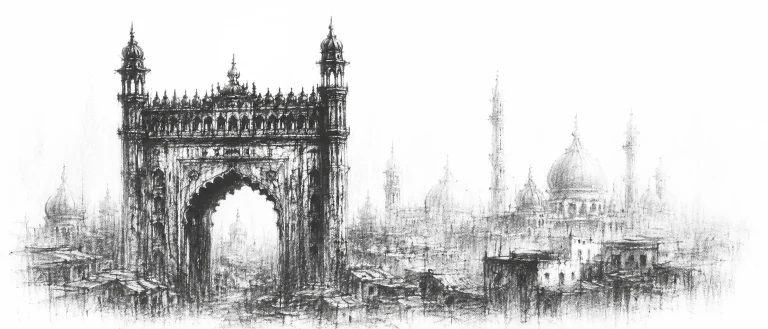
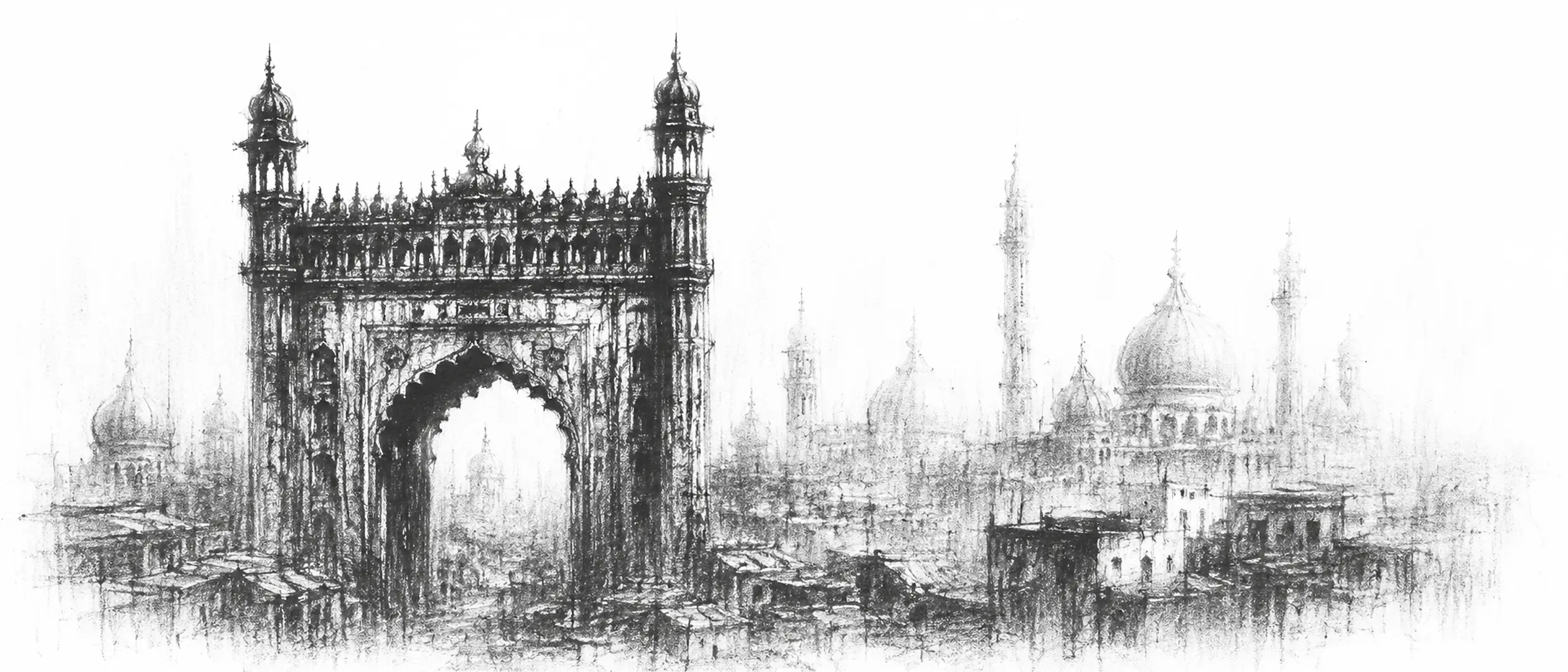
The temple itself I could not enter even if I went — it keeps its inner courts for the faithful of its own tradition, and the great spire is glimpsed mostly from outside, over the walls — and so the image that comes to me is the gateway, the high stone entrance flanked by carved guardian lions, the threshold rather than the sanctum. I find I do not mind that the heart of it is closed. I am drawn to thresholds, to the carved edge of a holy place, to standing at the gate of something rather than inside it, which is, after all, more or less my relationship to every place in this book. I would stand between the stone lions and look up at the spire I was not going to be allowed to approach, and feel oddly at home in that exact position.
When the god comes out onto the street
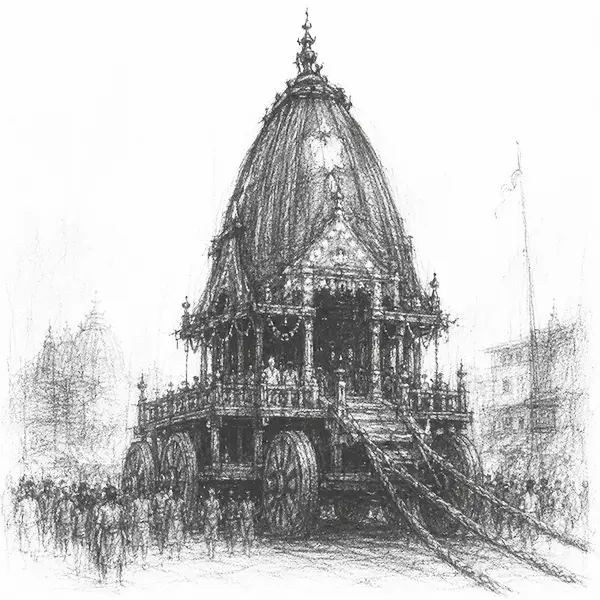
Once a year the town does the thing it is most known for — it builds enormous wooden chariots, tall as houses, with great solid wheels, and brings the deities out of the temple and down the wide avenue on them, hauled by thousands of people on thick ropes, the whole town and half the region heaving these mountains of timber through the streets. A festival of sheer collective muscle, of a god brought out of the dark of the sanctum into the open road for once, pulled by anyone who can get a hand to the rope. I am moved by the scale and the democracy of it, the idea of a holy day that the closed temple opens out into the street and gives to the crowd. I would put my own hand on the rope, just to have pulled.
The working shore behind the temple
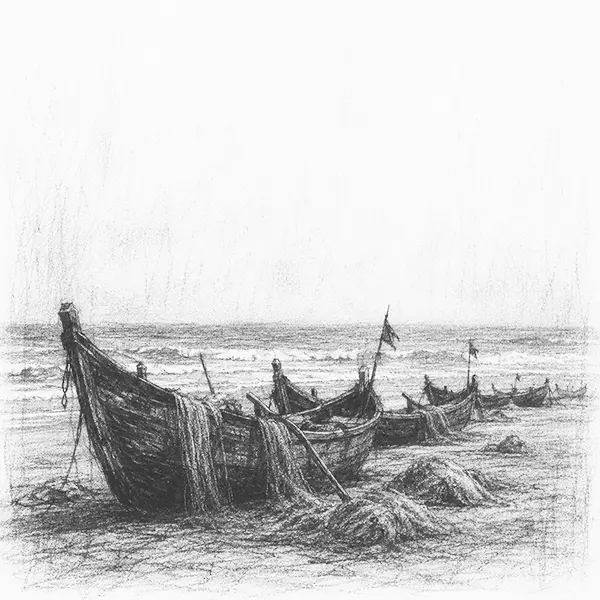
Behind the temple town lies the working shore — a wide grey beach where wooden fishing boats are hauled up on the sand, nets drying, the fishermen going out through the surf at dawn and coming back through it at dusk, a whole hard life lived at the edge of the same sea the pilgrims come to bathe in. I am always drawn to the working face of a place that is famous for something else, the labour going on alongside the holiday. The same stretch of sand is a sacred beach and a fishing beach at once, devotion and livelihood sharing the tideline. I would walk down to where the boats are drawn up and watch them go out, and like the town better for being a workplace as well as a shrine.
The conch at the sea’s edge
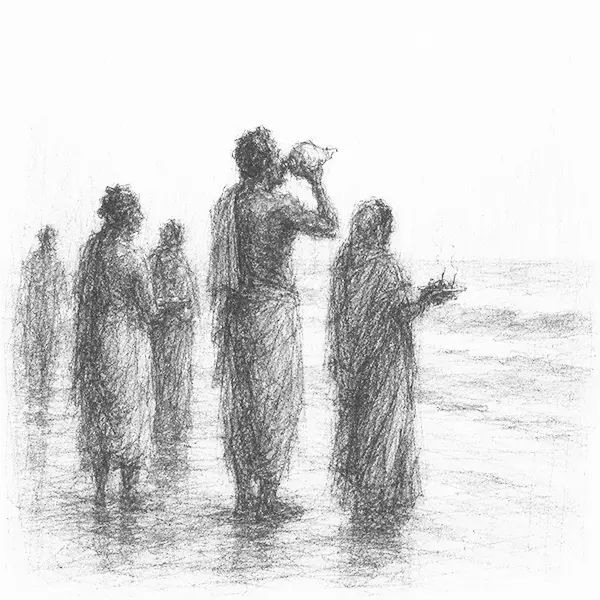
And the pilgrims themselves, the ceaseless river of them — coming in from everywhere, with their offerings and their conch shells and their small purchases, blowing the conch whose sound I have heard in every house I grew up around, performing at the sea’s edge the rites that bookend a faith. The conch above all reaches me, because it is the sound of my own childhood evenings, the note that meant the lamp was being lit. To hear it blown here, by the thousand, on a holy beach a night from home, would be to hear the most familiar sound of my life in the one place I never went to make it. I would stand among the pilgrims at dusk and let that sound go through me, and feel the odd ache of a homecoming to a place I have never been.
The sea at Puri, the bay I never met
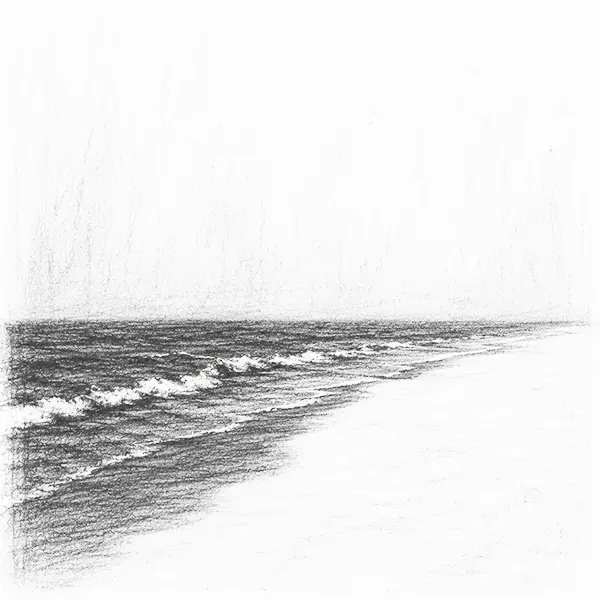
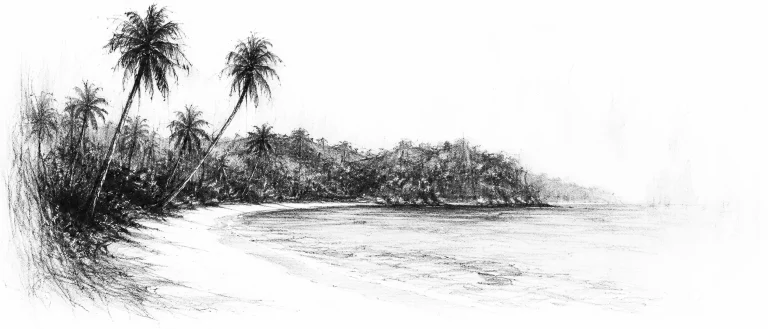
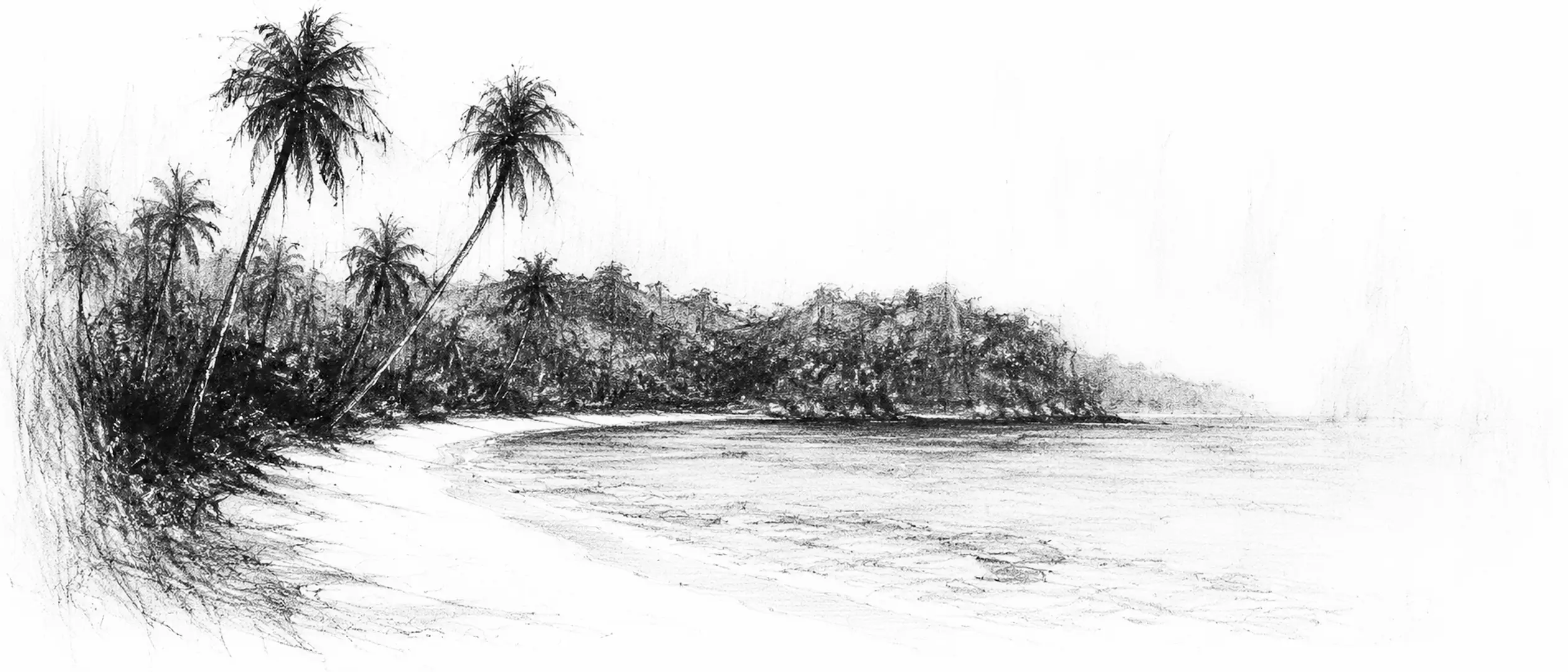
But the thing I think I most want is the simplest — the sea itself, the wide grey Bay of Bengal meeting a long empty stretch of sand, the same bay that washes the muddy edge of the city I was born beside, here grown clean and open and loud. It is my own sea, in a sense, the bay my rivers run into, met at a place where it has room to be itself. I have stood at its muddy northern corner all my life and never come down the coast to where it opens out. I would stand at the waterline at first light, with the temple behind me and the whole grey bay in front, and feel the plain pull of an ordinary sea I had somehow never bothered to properly meet.
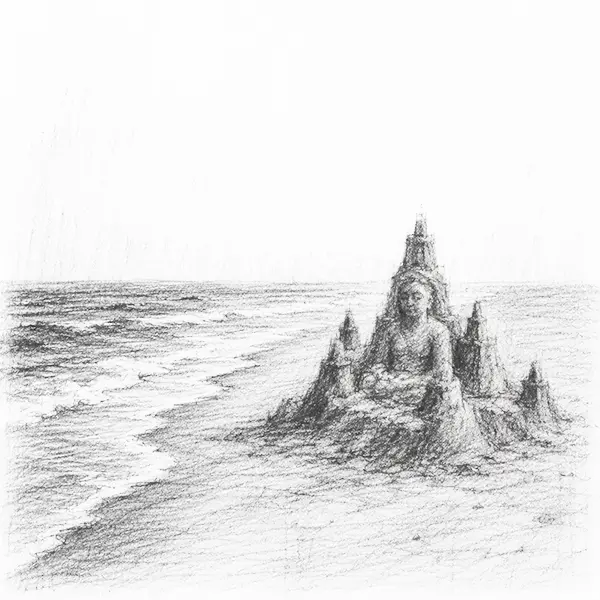
And the small modern grace note the beach is now known for — the sand sculptures, great careful figures and scenes built straight on the open sand by people who do it for the love and the skill of it, made to be admired for a day and then taken by the tide. I am charmed, as I always am, by an art that knows it is temporary and makes itself beautiful anyway, that builds something fine in the certain knowledge the sea will have it by evening. There is a lesson in it I keep almost learning. I would stand over one in the afternoon and watch the first edges of the tide reach for it, and not be sad, exactly.
So Puri sits in the near room with the strangest reproach of all — not far, not hard, not abroad, the single most ordinary journey my people make, and the one I never made. There is no ocean to blame, only my own sea, and no excuse but the oldest one, that a thing everyone does and you can do anytime is the easiest thing in the world to keep not doing. It is a temple town on my own bay, a night down the coast from my birthplace, that practically everyone I know has stood in, and I have not. One of these years I should finally take the ordinary train down the ordinary coast, and stand between the stone lions, and put my hand to the chariot rope, and hear the conch blown by the thousand at the edge of my own sea — and find out, at last, what everyone else has always known. A man who has never been abroad, and who has not even made the one journey his whole family makes without thinking.
“Puri: a coastal town in Odisha on the Bay of Bengal, one of the holiest pilgrimage centres in India, site of the great Jagannath temple and its annual chariot festival, and a popular seaside resort.”
— from a battered atlas, in the gazetteer at the back

Leave a Reply