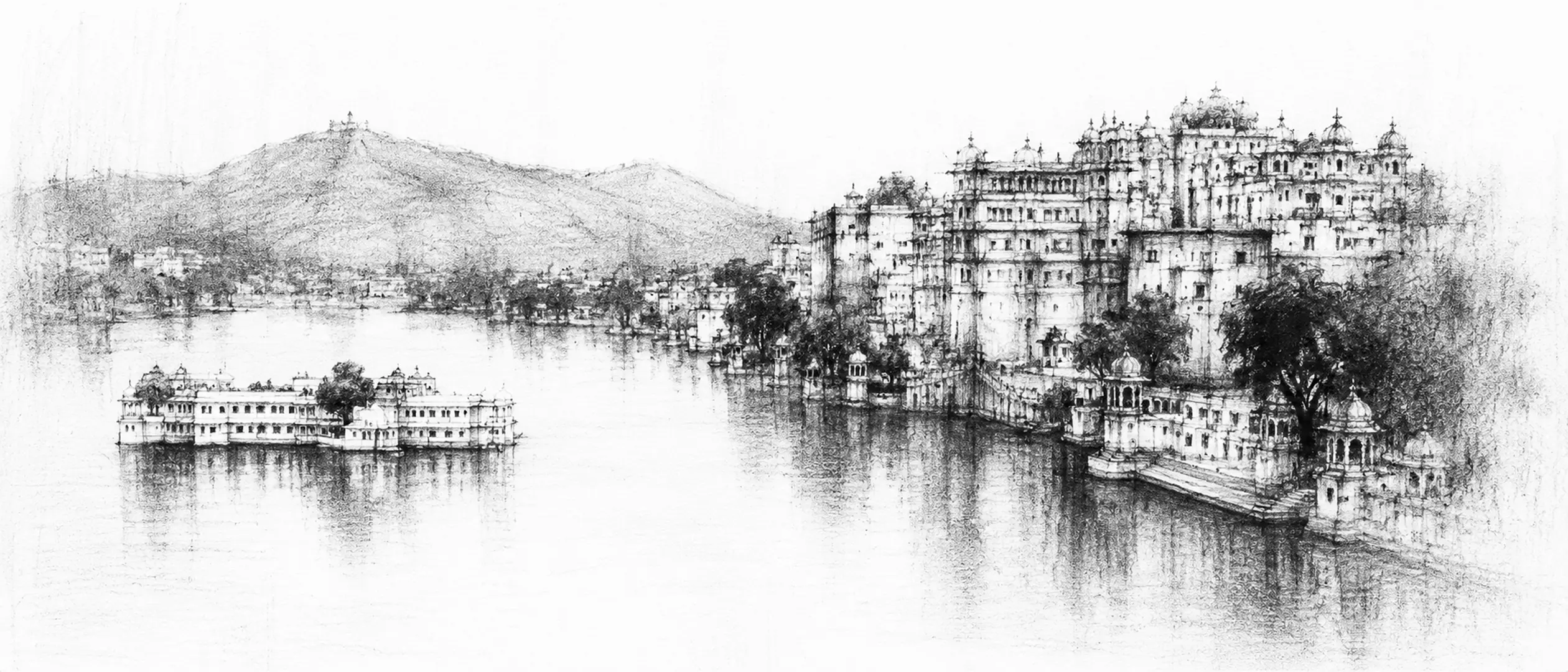
Within reach · never been
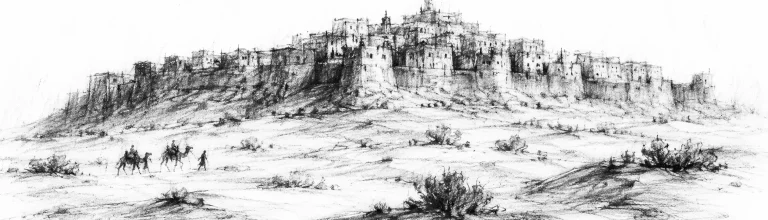
I have already written, in this book, about the golden desert fort to the west — about Jaisalmer, the colour of the sand it stands on, the dryness, the silence, the longest train ride. Udaipur sits in the same hard state, reached by much the same train, and is its complete opposite: not a city the colour of the desert but a city that refuses the desert outright. A place of white palaces set on and around lakes, water held improbably in the middle of a dry land, marble reflected in still green water under the same fierce sun. That Rajasthan should contain both, the bone-dry golden fort and the soft white lake city a day apart, is one of the things I find most wonderful about it, and I have managed, with my usual thoroughness, to reach neither.
It comes to me, as so much does, through other people’s photographs, and Udaipur is one of the most photographed places in the whole country. It is, frankly, theatrical, a city that looks staged, a white palace floating on a lake against brown hills, the kind of view that seems too composed to be real and is. The films love it. The honeymooners love Udaipur. It has been handed to me so often, in so many gauzy versions, that, like Paris, I half-distrust my own wanting of it, and want it anyway. There is a softness to it that is almost suspicious in a state I think of as all heat and stone, and I would like to stand on a shore and find out whether the softness survives contact.
The palace that floats on a lake in Udaipur
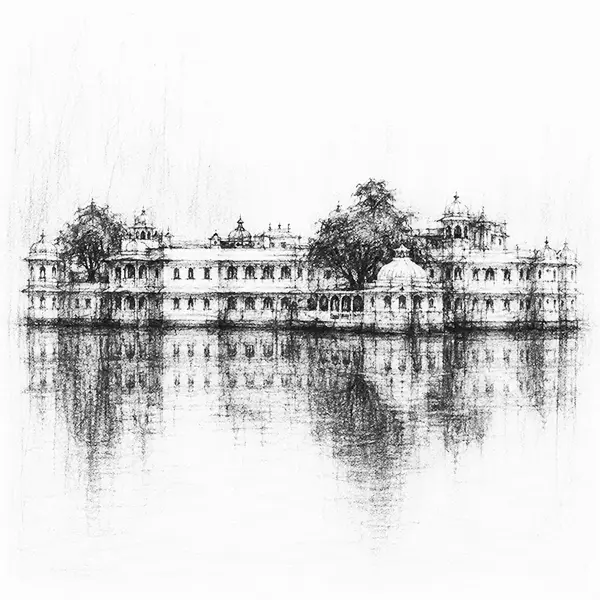
The image, of course, is the palace on the water — a low white marble palace that fills its small island so completely it appears to float, unmoored, in the middle of the lake, reachable only by boat. It is reflected whole in the still surface, so that from a distance you cannot quite tell the building from its double. It is the picture that made the place famous and it has not worn out for me, the sheer improbability of it: a palace built not beside the water but in it, a king’s whim made of marble, sitting out there on its own reflection. I would like to see it at the hour the photographs love, when the light goes and the white turns to gold and the whole thing seems to hang between the water and the sky.
A stone diary of a dynasty
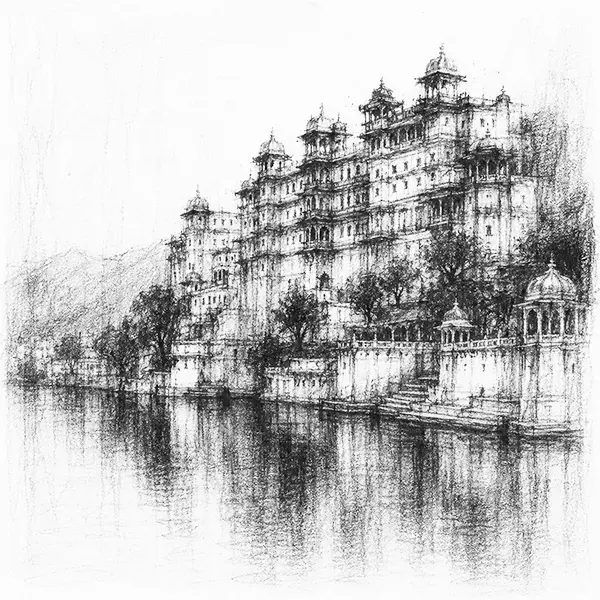
Along the shore stands the other palace, the great one — an enormous tiered city-palace running for a long stretch above the lake, balconies and turrets and screened windows piled up storey on storey, the largest of its kind in the state, grown over centuries by one king after another adding his wing. I am drawn to those rambling additive palaces, built not to a single plan but by accumulation, each generation leaving its mark until the whole thing becomes a kind of stone diary of a dynasty. I would want to get lost in it, in the courtyards and the mirror-rooms and the high balconies, and come out somewhere unexpected over the water.
Marble shelters for doing nothing
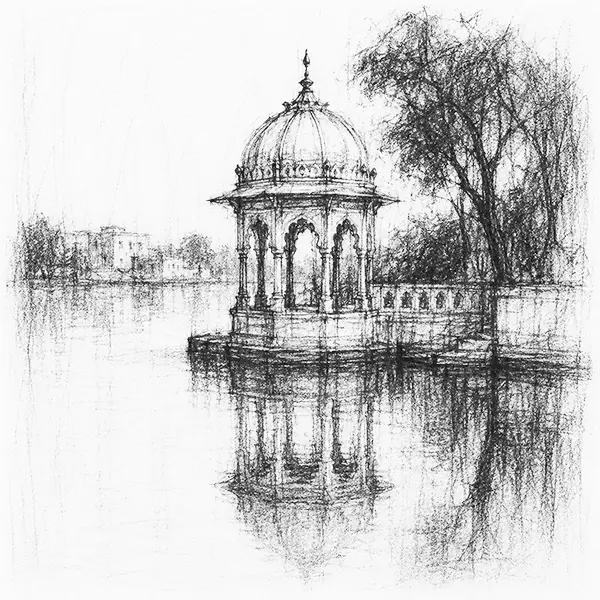
It is a city of pavilions — small domed marble kiosks set at the water’s edge and out on the islands, open little buildings made for nothing but sitting in the shade and looking at the lake, their domes doubled in the still water below. There is something about a building made purely for the contemplation of a view that I find deeply sympathetic. A culture that, in the middle of a desert, built itself delicate marble shelters whose only purpose was to be a beautiful place to do nothing beside the water understood something about leisure, and about water, that a hot dry country earns the hard way. I would sit in one for an afternoon and consider it time extremely well spent.
The city seen from its water
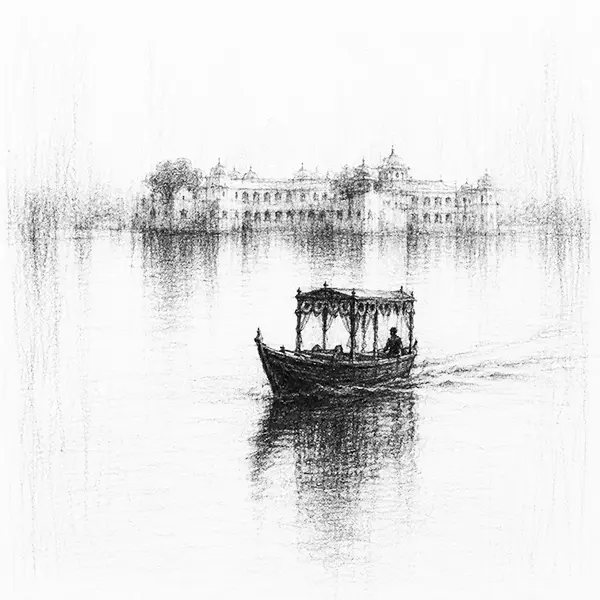
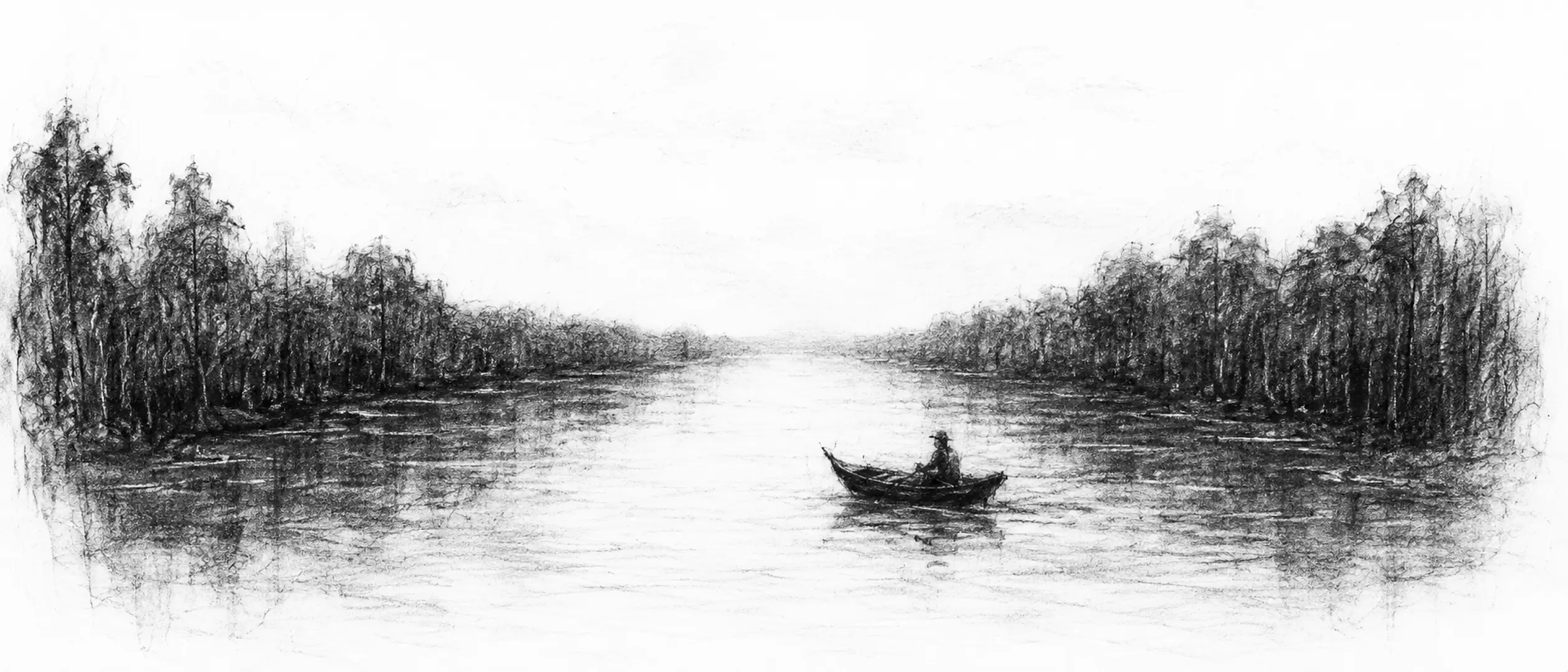
And the boats, because the whole city is arranged to be seen from the water — small craft crossing the lake between the palaces and the ghats, carrying people out to the floating palace and back, leaving a slow wake across the mirror. To see a city from its lake, drifting, the palaces sliding past and doubling in the water, is plainly the right way to see this one, the way the place was designed to be approached. I have crossed a great deal of working water in my life. The idea of crossing a still ornamental lake purely for the beauty of the crossing is a small luxury I would not refuse.
A hundred carved frames on the water
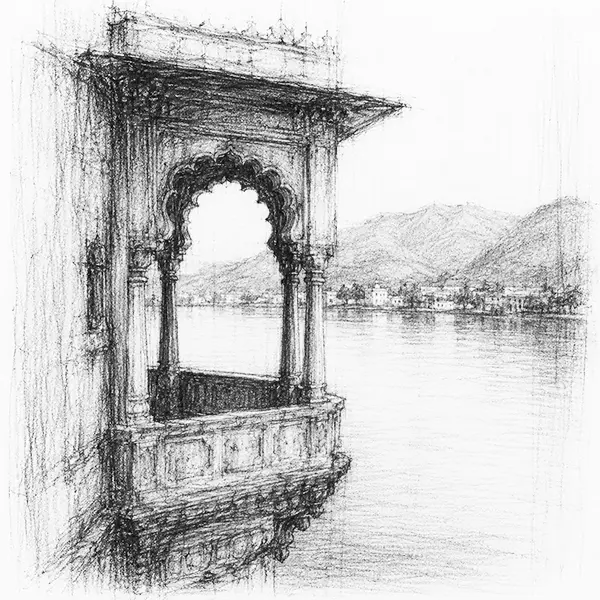
What I would look for, in the end, is a particular small thing the photographs are full of without meaning to be — an arched stone balcony, a jharokha, leaning out over the lake from one of the old buildings, a carved frame around a rectangle of water and hills and sky. The whole architecture of the place is about framing the lake, cutting it into views, giving you a hundred carved windows to see the same water through. I would like to lean on one of those balconies, in the heat, with the lake below and the dry hills beyond, and understand the strange luxury of a desert people who taught themselves to frame and reframe the one thing their land does not have.
The defiance under the softness of Udaipur
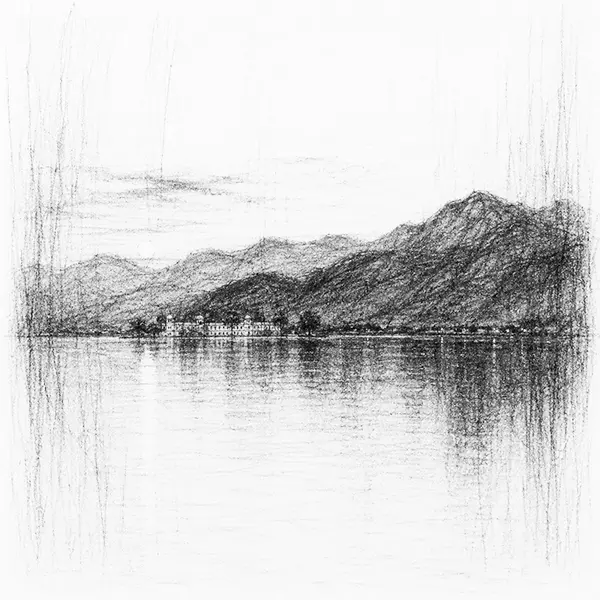
For it is, always, a desert in the end — the lakes ringed by dry brown hills, the water a thing held against the land rather than given by it, the whole soft white mirage sitting in a hard country that would take it back in a season without the dams and the care. That is the part that moves me most, now that I think about it: not the romance the honeymooners come for but the defiance under it, a people who looked at a dry valley and decided to make lakes and float palaces on them, softness manufactured in spite of the place rather than because of it. I would want to stand on one of those brown hills at dusk and see the whole improbable thing laid out below — the water that should not be there, and the white palaces floating on it anyway.
So Udaipur joins its golden sibling in the same plain predicament — a long train west into a state I keep meaning to reach and never do, no ocean, no border, no excuse but the usual. I have now failed to go to both the dry fort and the soft lake city, the two faces of the same desert, each a day’s travel from the other and both a sleeper train from where I have lived. One of these years I should take that train at last, and see them together — stand on the golden walls at one end of the week and float on the white lake at the other, and finally hold in one head the two impossible things the same hard country somehow makes. I have never been abroad, and I cannot even reach the two faces of one desert a single train apart.
“Udaipur: city in southern Rajasthan, founded in the sixteenth century around a series of artificial lakes; known for its white marble palaces, among them a former royal residence set on an island in the largest lake, and ringed by the dry Aravalli hills.”
— from a set of travel books once sold to the house, door to door

Leave a Reply