Within reach · never been
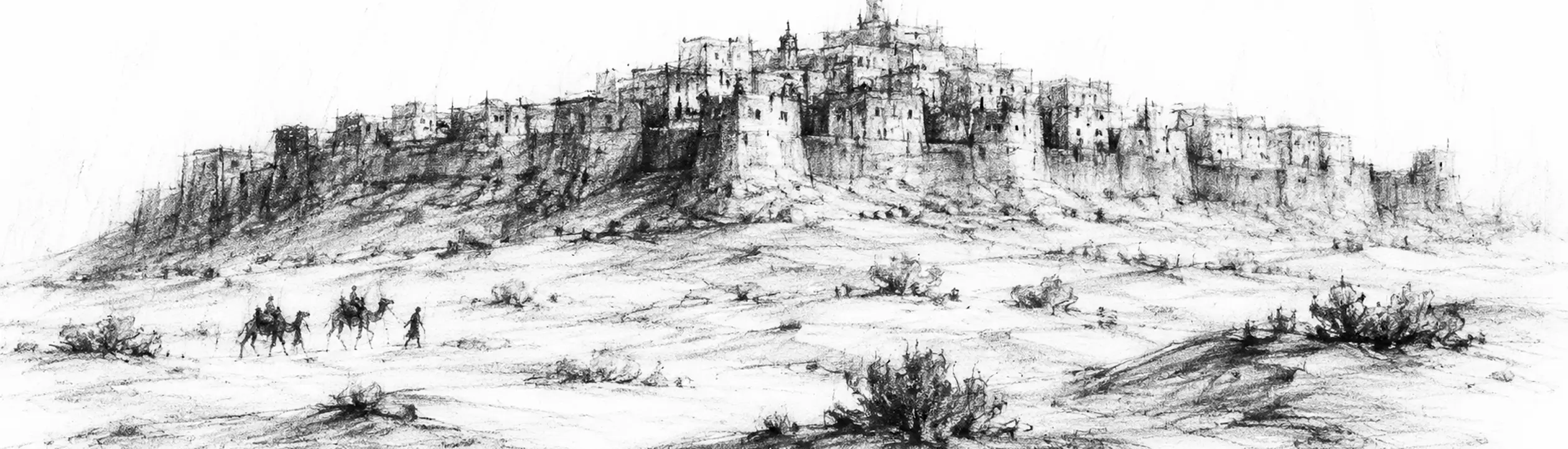
Jaisalmer came to me earlier than almost anywhere else in this book, and it came to me in black and white. There was a film I watched as a small boy — Sonar Kella, the golden fort — a children’s detective story, the kind every child of my language grew up on, in which a boy and the detective who looks after him chase a small mystery across the desert of Rajasthan and end up at a great fort built, the film kept insisting, of gold. The whole story turned on that fort and its colour. A golden fortress, everyone said, gleaming in the sand. And I sat in front of a television that showed the world in grey, and I looked at this fort that the entire film told me was golden, and I could not, for the life of me, see it. It was ash and silver and soft black, like everything else on the screen. The word and the picture would not meet.
That gap stayed with me for an unreasonably long time, and I have come to think it is where this whole strange habit of mine began — the wanting of places I cannot quite see. I knew the fort was golden the way you know a fact you have been told and cannot check. I just could not picture it. I would lie in bed and try to colour the grey fort in with my mind, and fail, because I had no gold to colour it with; I had never seen sandstone burn in a desert evening, had never seen that particular honey light, and so the most important thing about the most golden place I knew remained, to me, a rumour. A fort the colour of a word I did not have.
Jaisalmer in colour, at last
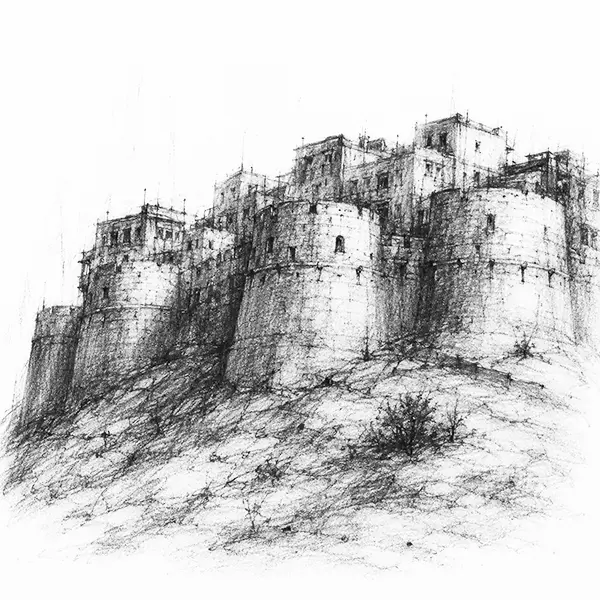
I did not see it in colour until I was a grown man. It was the late nineties, and the internet had just arrived in our lives, slow and miraculous, and one idle evening it occurred to me to go looking for the golden fort of my childhood — and there it was, suddenly, in colour at last: the actual stone, the actual honey-gold of it, the whole fort lit up like a coal in the low sun of the desert. Twenty-odd years after I had first been told it was golden, I finally saw what the word had meant. I remember the small shock of it, the click of a thing long promised and at last delivered. And underneath the pleasure, a quieter thing: that I had had to wait two decades and cross half the world’s new wires to see the true colour of a fort that stood, the whole time, a single long train ride from where I lived. I had solved the colour. I had still never been.
Where the sand decided to stand up
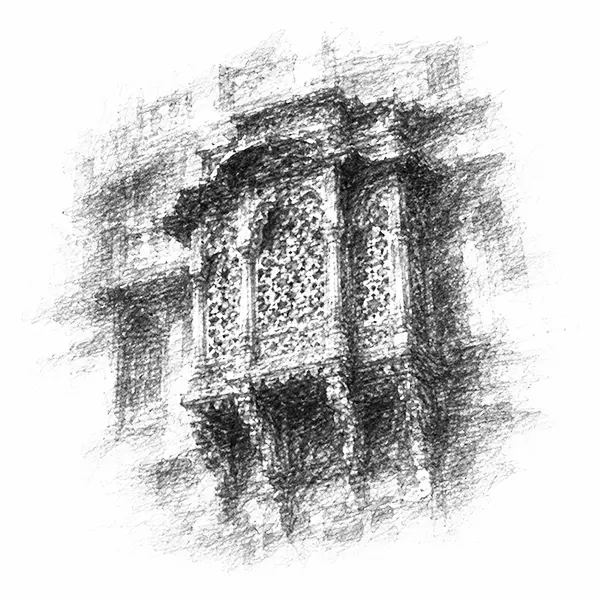
Because it is, of course, reachable — almost embarrassingly so, by the standards of the far cities I keep here. No ocean, no visa, no border. A night and a day on a train heading west into the Thar, into the dry country where the rivers give up, and there it is: not a ruin, which is the thing I had not understood as a boy, but a living fort, one of the last in the world that people still live inside — a whole town of golden sandstone packed within the walls, lanes and temples and houses and shops, all of it cut from the one yellow stone, so that the fort does not sit on the desert so much as rise straight out of it, the same colour, as if the sand had decided, in one place, to stand up.
Stone lace, and a silence I have wanted
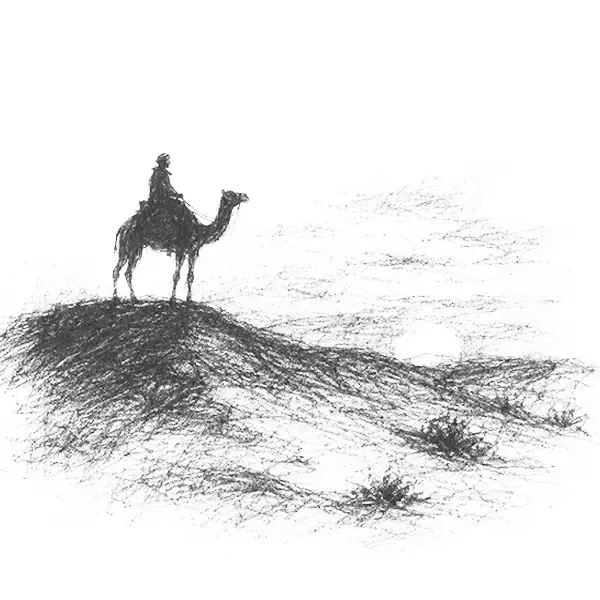
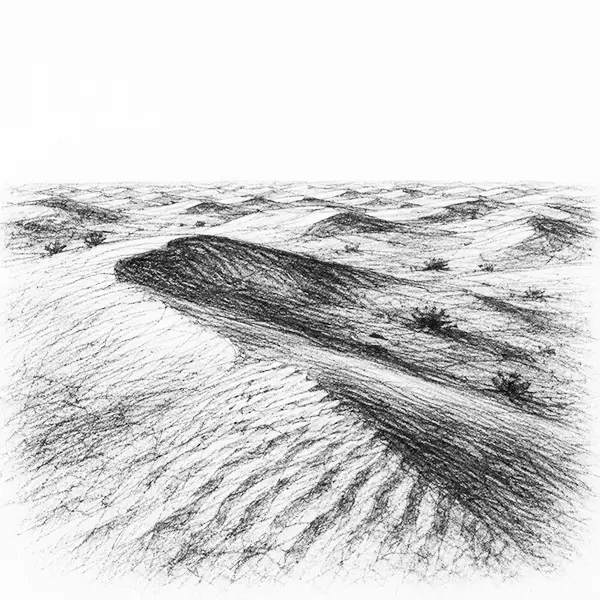
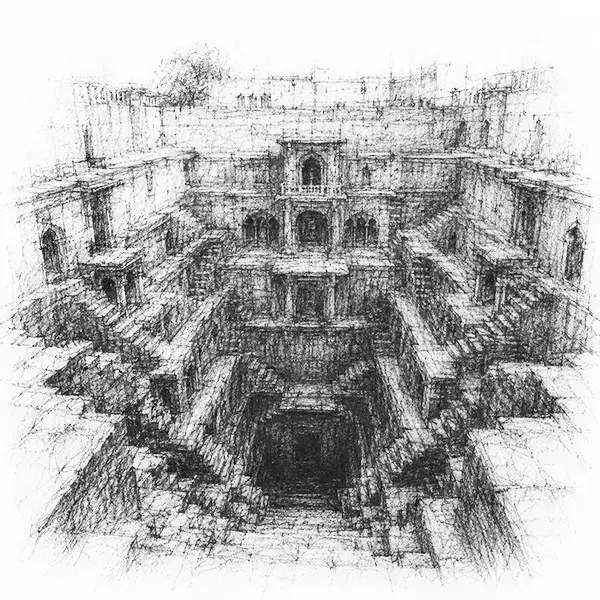
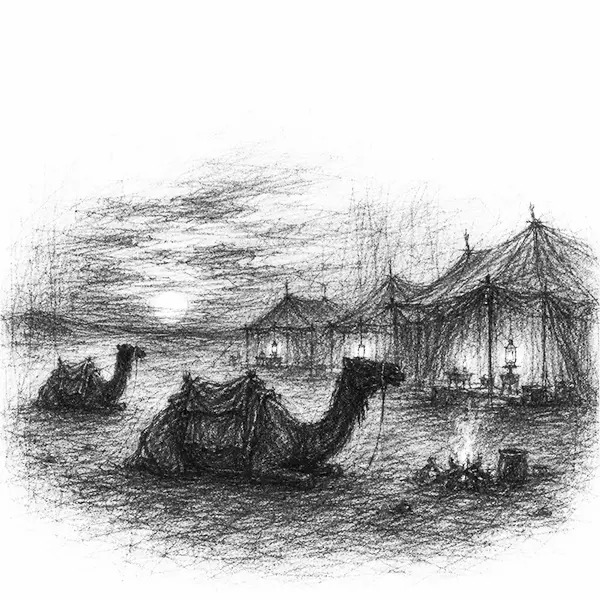
And the things the colour film finally showed me, that the grey one could not. The havelis — the old merchants’ mansions — with their fronts carved into stone lace so fine it looks crocheted, screens you can see through and never quite see, shade thrown in patterns on the floor. A great old stepwell going down in flights to the dark water, the steps worn, the whole thing built upside down into the ground against a sky with no rain in it. And beyond the walls the desert itself, the dunes the photographs all catch at the same hour, wind-rippled and going gold and then rose and then grey as the sun drops, a camel and its rider stark on a ridge against the burning sky, the particular enormous silence of a place with almost nothing in it. I have wanted that silence for a long time. My whole life has been loud and crowded and warm; the desert is the one landscape that promises the opposite, and promises it in gold.
Jaisalmer, loved in grey for twenty years
I have collected the rest the usual way — documentaries on the desert towns, magazine spreads, the photographs friends bring back from the camps out among the dunes, where they ride camels they are a little afraid of and sleep under a sky they cannot get over. But it is the film I keep coming back to, the first source, the grey one. There is a particular sweetness in having loved a place for its colour for years before I had ever seen the colour — in having taken it entirely on faith, the way you take so many things on faith as a child, that the world is more golden than your evidence for it. I have never minded that the proof came late. I rather like that, for twenty years, the most golden place I knew was one I had only ever seen in grey.
So here is where I land, and it is the same plain place I land with every Indian dispatch, made a little sharper by the gold. I cannot blame an ocean or a border or a fortune. It is a train, a long and not even uncomfortable train, west into the desert, to a fort I have known by name since before I could properly read, whose colour I have now seen, whose lanes I could probably half-navigate from other people’s footage. The boy who could not picture the gold grew up, found the gold, and still has not gone and stood in it. There is a joke in there about a man who would rather keep a thing golden in his head than risk the actual sun on the actual stone, and I am, I am fairly sure, the punchline.
So I keep the golden fort the way I have kept it since I was small, except now I know the colour. It rises out of the sand the colour of the sand, and at evening the low sun gets into the stone and the whole thing glows like something lit from within, exactly as a grey television once swore to me it would and could not show me. The havelis throw their lace shadows. The stepwell goes down into the dark. A camel and a rider stand on a ridge against a sky going from gold to rose, and the silence comes down over all of it. I have seen it now, in colour, on a screen, twice the boy’s age. One of these years I should go to Jaisalmer and let the desert finish the job the television started, and see, at last, in the one place I have wanted longest, whether the gold is as good in the eye as it has always been in the word. I have never been abroad, and even this golden corner of my own country I have only ever been shown.
“Jaisalmer: fortress city in the Thar Desert of western Rajasthan, founded in the twelfth century; built of the local yellow sandstone that glows gold at sunrise and sunset, and one of the few inhabited forts still lived in today.”
— from a guidebook I bought for a journey I never made

Leave a Reply