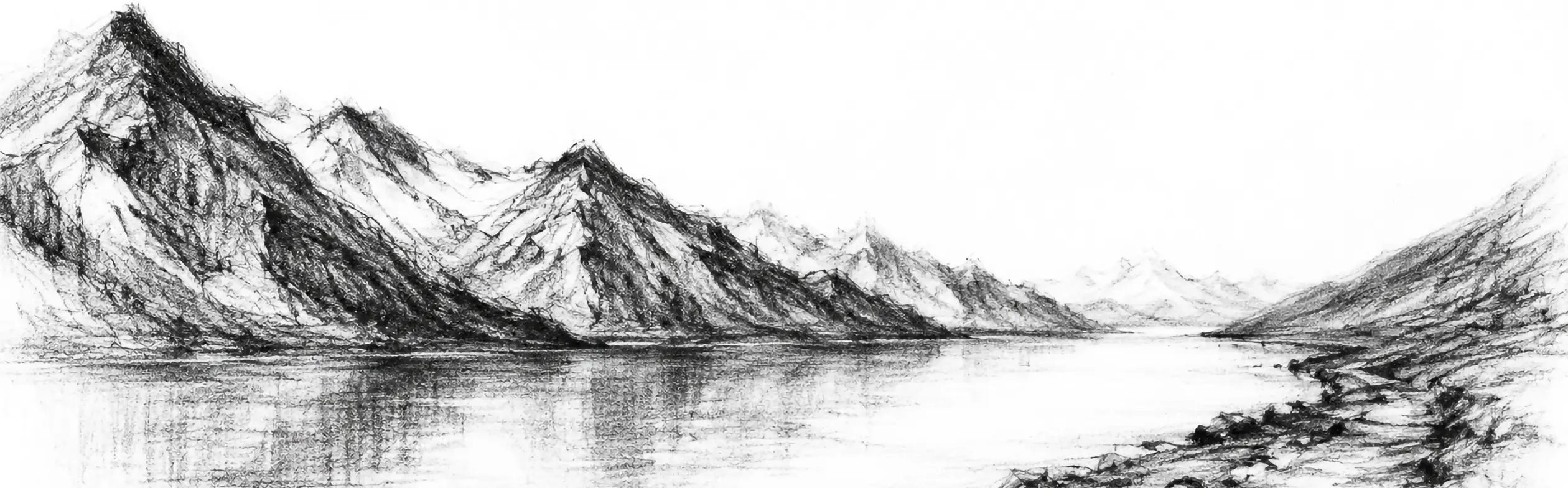
Within reach · never been
Ladakh is the place I have the fewest excuses about. The cities in the rest of this book have an ocean and a visa between us, and I can hide behind those — the cost, the distance, the whole machinery of going abroad. Ladakh asks for none of it. It is in my own country. No border guard, no foreign currency, no permission a citizen cannot get for the asking. It is a flight of a couple of hours, or a hard glorious drive of a few days, from places I have actually lived. By every measure that lets me off the hook for the others, I have no business not having gone. And I have not gone. Which makes this the most honest entry I will write, because there is no ocean here to blame. There is only me, and a high cold desert I have wanted to stand in for twenty years, and the curious distance between the two.
It does not help that everyone has been. Ladakh is no secret; it is the great Indian pilgrimage of the able-bodied and the restless, and I have watched a whole generation make it without me. A former colleague rode up there on a motorcycle over the high passes and came back thinner and quieter and changed in a way he could not put into words, which is the only kind of travel story I ever fully believe. There is a hit film, I am told — I have not seen it — that planted a yellow scooter on the shore of a far blue lake up there and turned the spot into a place where thousands now queue to take the same photograph. My own country’s most photographed emptiness. I have seen ten thousand of those photographs and ridden none of those passes, and the gap between the seeing and the riding has grown, by now, to roughly the size of the mountains themselves.
Ladakh, a cold desert in the sky
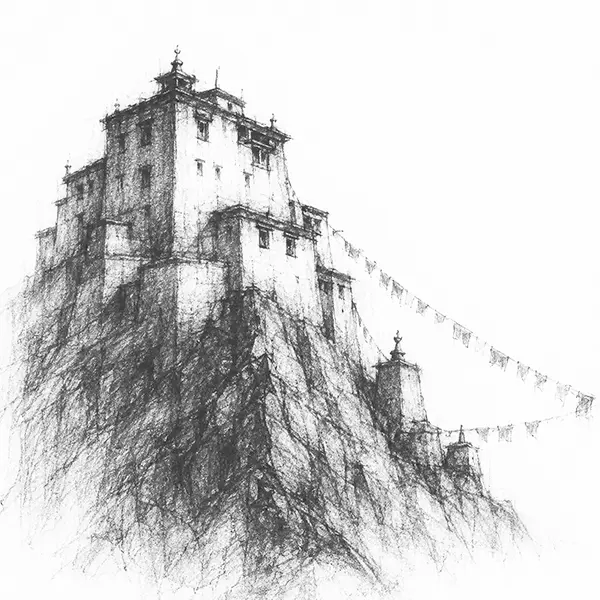
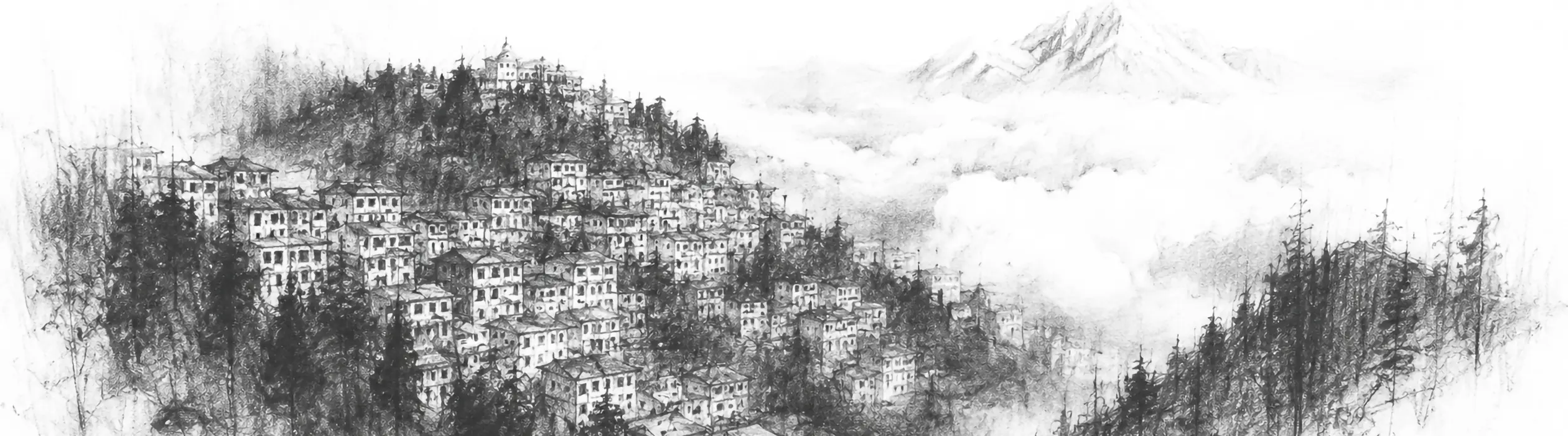
What I have built, from the photographs and the hushed documentaries, is a country that does not look as though it belongs to the same planet as the green wet plains I come from. A cold desert — that contradiction took me years to hold in my head — bare brown mountains with not a tree on them anywhere, snow on the high tops, and a sky so thick a blue it goes almost black at the edges. Whitewashed monasteries stacked up the sides of crags as if grown there rather than built, prayer flags strung from every high point and worn to threads by a wind that never fully stops, sending their printed words out over the valley a few at a time. And the thinness of the air up there, which the body apparently refuses at first — a headache, a shortness, a heart working too hard for a man who is only standing still. I have wondered, more than once, whether my own would manage the height. I suspect I have used that wondering as one more comfortable place to hide.
Barley green against the brown
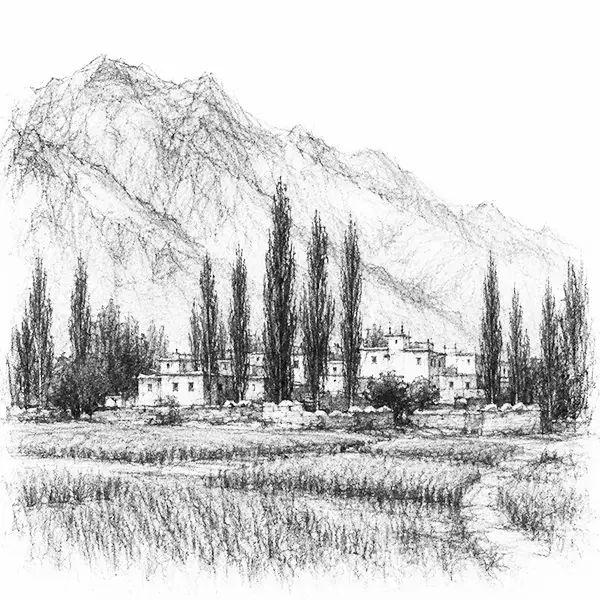
And then, set into all that bareness, the green comes as a shock. The photographs that move me most are not of the famous lake at all but of the small villages — a sudden patch of barley, an impossible row of poplars standing dead straight against the brown, apricot trees, a stream pulled down off the snow and made to run between fields by hands that have been doing exactly that for a thousand years. People have farmed the few short weeks of summer up there since long before any of the borders now drawn around them existed. A young river runs through it, cold and grey with rock-flour, that becomes — much later, much lower, very far from there — one of the great rivers whose name was handed to my entire civilisation. It is strange to think the water has further to fall than I have ever travelled. I keep that thought somewhere it cannot embarrass me.
But the lake is the thing I cannot let go of, and not only for its colours, though the colours are the headline — a long thin sheet of water at a height where water has no business staying liquid, changing through a single day from hard turquoise to deep blue to a flat pewter grey, depending on the sun and the cloud and, it seems, its own mood. What holds me is a fact the postcards leave out. The lake does not stay in my country. It runs east for a hundred-odd kilometres, and well over half of it lies in another country, the line between the two drawn invisibly across open water and watched by soldiers on both shores, a quiet cold standoff at the roof of the world. You cannot follow that beautiful lake to its end without leaving India. And of all the places to find it: a man who has never once crossed a border, in love with the one lake in his own country that turns into abroad if you go far enough along it. The border I will never cross runs straight through the most beautiful water I have never seen.
The long road up to Ladakh
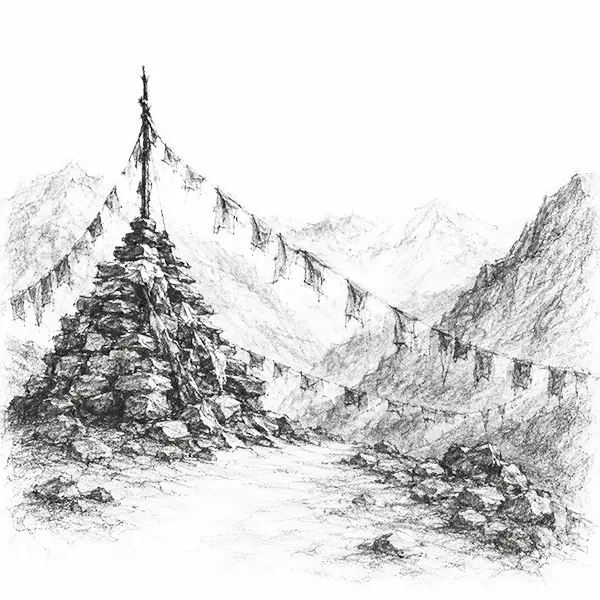
Part of what I want is not the arriving but the going — the road itself, which is half the legend. Passes so high the signboards boast about it, the engine thinning along with the air, switchback after switchback with nothing at all at the edge, a cairn of stones at the top hung with so many prayer flags it has gone soft and shapeless, and a small painted sign congratulating you for having got that far. Convoys of army trucks grinding up the same grades, because this is a frontier and has the soldiers to prove it. People say the going changes you more than the place does — that something in the long climb and the scarcity of air and the absence of everything familiar does the work, and you arrive at the lake already altered, ready for it. I would like, very much, to be changed by a road. I have driven a great many roads. None of them, so far, has managed it.
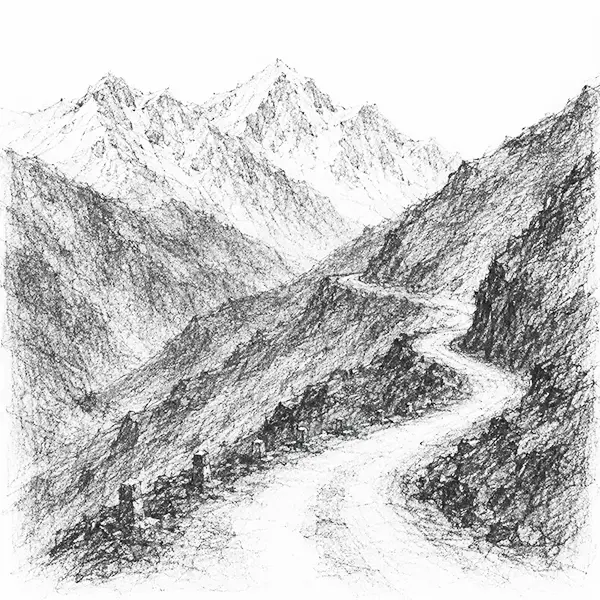
Here is where, for the foreign cities, I would reach for the ocean and the visa and the expense. I do not have them here. The truth about Ladakh is plain, and a little cruel: nothing has kept me from it but myself. Not money — my own trips inside this country have cost me as much as a flight to somewhere with a different alphabet. Not permission — I am a citizen; the place is mine by birthright. Not danger I could not manage with some sense and a few days to let the body adjust. Only the same soft daily failure, which abroad I can dress up in logistics and which here stands in the open with nothing on. When the thing between you and a place is a whole ocean, you can almost respect it. When the only thing in the way is you, it is harder to look at directly. So mostly I have not looked.
So Ladakh sits in a different room from the rest, the one marked *not far enough away to excuse it.* The bare brown mountains, the green villages tucked into them, the monasteries on their crags with the flags going to threads, and the long lake changing colour at a height I have never breathed at, running quietly east until it stops being my country at all. It is the most reachable place I have never reached, which makes it the truest thing in this whole collection. The passport stays clean for the cities across the water. For this one I cannot even blame the passport. I can only note, as I have now been noting for twenty years, that the road is open, the season is short, and I have once again let the summer go by without driving north. I have never been abroad, and this is the one place I cannot even blame the passport for missing.
“Pangong Tso: a brackish lake in the Ladakh Himalaya at about 4,350 metres, roughly 134 km long, of which well over half lies beyond the Indian line of control; despite its salt, it freezes solid end to end through the winter.”
— from a documentary I keep meaning to finish

Leave a Reply