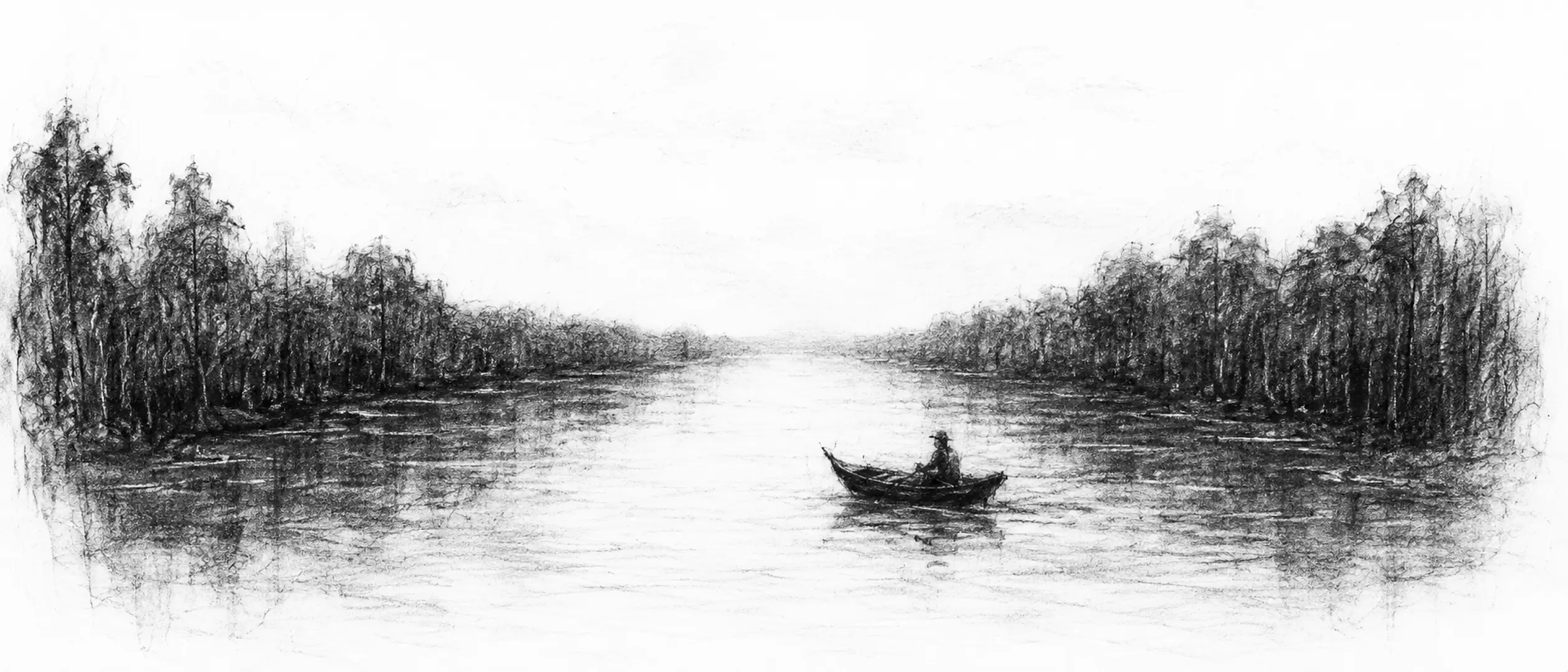
Within reach · never been
I grew up a few hours north of the Sundarbans and have never once gone down to them. They lie at the very bottom edge of my own home state, where the great rivers I grew up beside finally lose themselves in the sea: a vast, flat, drowned forest of mangroves spread across a maze of tidal islands and brown creeks, the largest forest of its kind anywhere. It is wild in a way almost nothing else in my crowded part of the country is, famous above all for a tiger that swims between the islands. They are the wild lower hem of the very land I am from, where the familiar rivers go feral and run out into the bay. And still I have never been to Sundarbans.
This is the sharpest of all the near-misses, because it is not merely near — it is mine, in the sense that anything is mine: the end of my own rivers, the wild edge of my own state, the place that sits at the bottom of the map I have carried in my head since childhood. Everyone from my corner of the country knows the Sundarbans the way you know a thing in the next room: the tiger, the honey-gatherers who go into the forest and do not always come back, the deity both Hindus and Muslims pray to before entering, the sheer brown watery danger of it. I have known all of that my whole life as a kind of background fact. I have never once gone down to stand at the edge of it and look in.
I have it, then, the way I have every place in this book — documentaries above all, the long patient ones that wait for the tiger that mostly does not come; photographs; the encyclopedia; and the whole web of story that runs through my region’s imagination, where this drowned forest sits as the wild place, the edge beyond the edge. Between them they have built me a country of brown water and green wall and grey mud, of silence and tide and the constant sense of being watched. I have never felt that particular watched silence. I suspect it would not leave me for a long time.
The Sundarbans is all edge, no centre
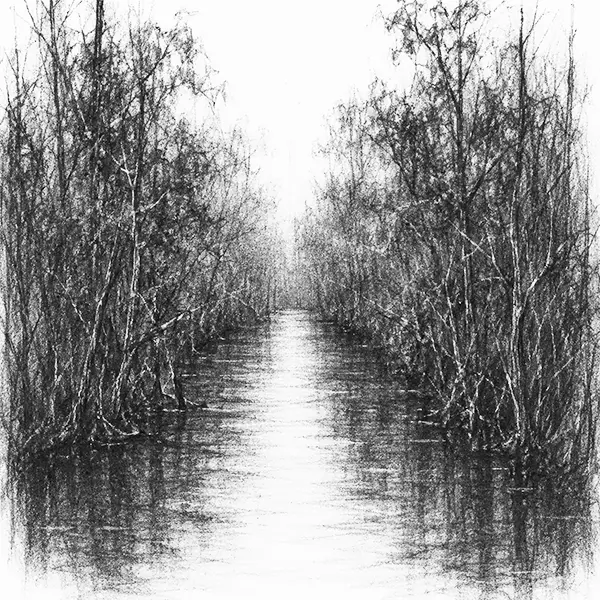
The whole place is creeks — narrow brown channels winding back into the forest between unbroken walls of mangrove, the green coming right down to the waterline on both sides, dense and tangled and shut, so that to go in is to slide between two solid hedges of forest along a ribbon of muddy water with no bank to land on. I am drawn to the back ways of any place, the working watery edges the maps barely bother with, and here the whole place is back way, all edge and no centre, a forest you can only enter by water and never quite enter at all. I would want to go up one of those narrowing creeks in a small boat, the green closing in on both sides, until it was too tight to go on, and then sit still and listen.
Where even the land is only borrowed
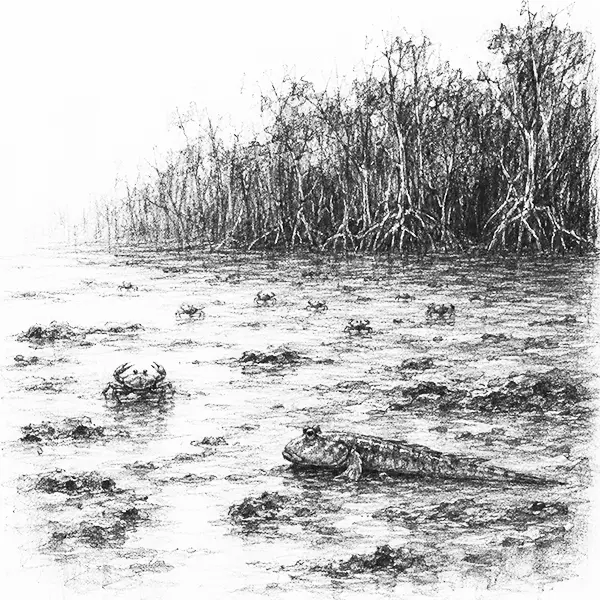
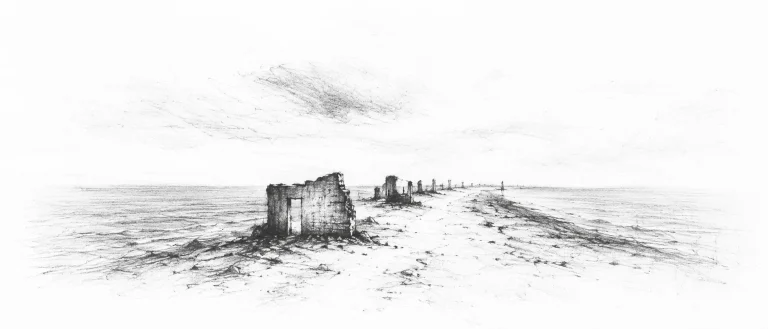
Twice a day the tide goes out and the whole forest changes — the water drains away down the creeks and leaves wide glistening banks of grey mud, alive with small things, armies of little crabs and the odd flat-headed fish that hauls itself across the mud on its fins as if the sea had not finished deciding whether to let it leave. A landscape that is liquid and solid by turns, that you cannot read until you know the hour of the tide. I am fascinated by a place so ruled by water that its very ground appears and vanishes twice a day, that has no fixed shore at all. I would want to be there at the turn of the tide and watch the mud come up shining out of the falling water, and the small life come out onto it, and understand that here even the land is only borrowed.
A forest standing on tiptoe in the salt
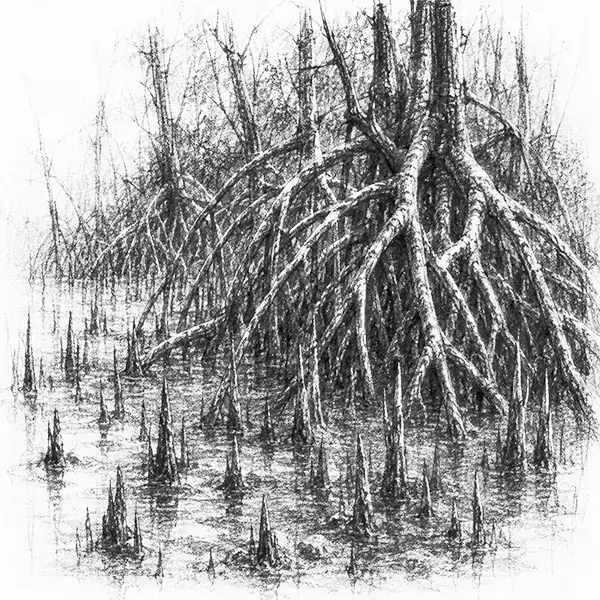
And the mangroves themselves, when the tide is low, stand revealed on their roots — thousands of pale woody spikes pushing up out of the mud around each tree, and great arching stilt-roots holding the trunks clear of the water, a whole forest standing on tiptoe in the wet, breathing through the mud. There is something almost uncanny in it, trees that have learned to live with their feet in the salt tide, holding themselves up out of the drowning ground on a tangle of roots. I am moved, as I often am, by living things that have made an arrangement with an impossible place and kept it. I would walk a boardwalk over that bared and rooted mud and look down at a forest that solved, root by root, the problem of standing in the sea.
The presence in the green wall
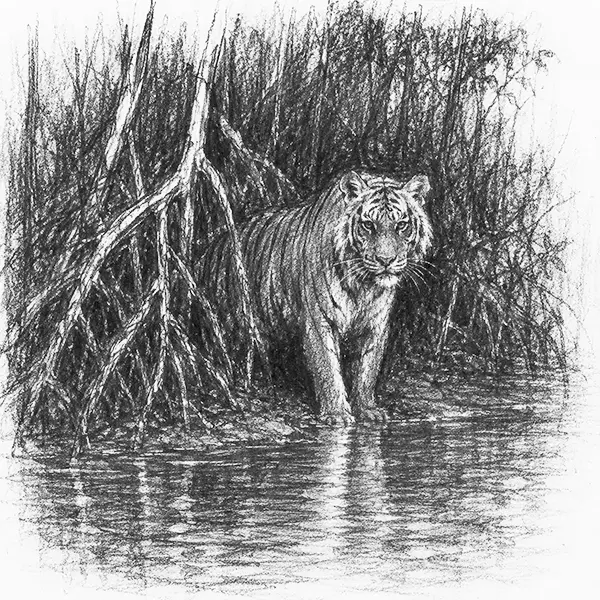
And then the thing the whole place turns around, the reason it is spoken of in a lowered voice — the tiger, the great swimming tiger of the delta, that crosses the creeks from island to island, that the honey-gatherers go in fear of and pray to keep away, the one big predator in my crowded region that still, genuinely, hunts people, and is feared and half-worshipped for it. Almost no one who goes ever sees it; that is exactly the point of it. It is a presence rather than a sight, a knowledge that something enormous is in the green wall watching, whether it shows itself or not. I do not especially want to see it. I want to feel it there, the way the boatmen feel it there, and know that my own home state still keeps one corner where I am not the top of the order.
The weather you fish in
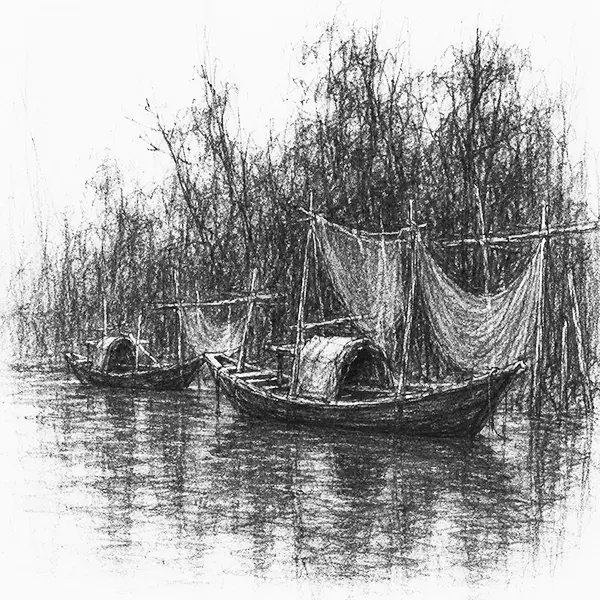
People do live at the forest’s edge, hard, on its terms — fishermen in wooden boats working the channels, nets hung up to dry, villages on the few islands solid enough to hold them, lives lived in genuine daily negotiation with the tide and the forest and the thing in it. I am always drawn to the people who make an ordinary living at the edge of an extraordinary danger, who go out each day onto water that might keep them and come back as if it were nothing. I would want to watch the boats go out at the turn of the tide, nets hanging, and grasp that for the people here the whole grand wild terror of the place is simply the conditions of work, the weather you fish in.
A watchtower over the Sundarbans
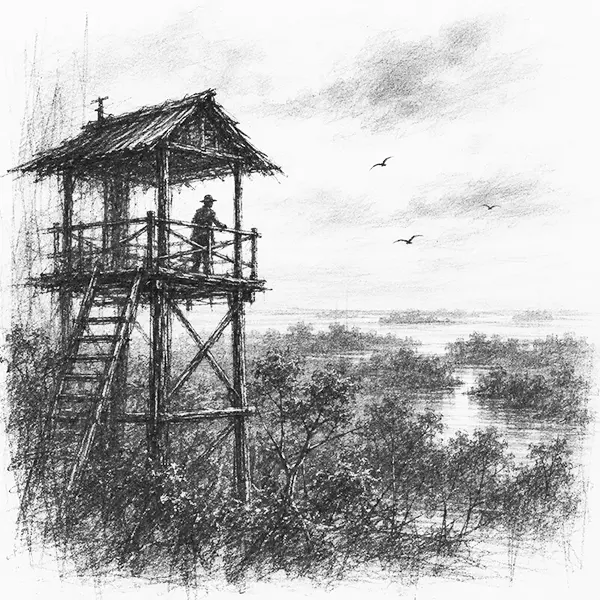
Here and there a watchtower rises above the green — a simple raised platform where you can climb up over the top of the forest and look out across the whole flat endless spread of it, creek and island and creek to the hazy horizon, in the hope of catching, at a waterhole below, the animal everyone comes for and almost no one finds. I am fond of the high lookout over a wild place, the patience it asks, the long odds of it. I would climb one and stay up there far longer than was reasonable, scanning the green and the mud and the brown water, not really minding whether the tiger came, content simply to be looking out over the wild lower edge of my own country at last.
So the Sundarbans sit at the very bottom of the near room — not far, not hard, not abroad, the wild hem of my own home state, the end of my own rivers, a few hours south of where I was born, and never once visited. There is real water here, real danger, a genuine wildness, which almost lets me off — except that the boats go down every season and the people live there all year, and I, who am from this exact land, have stayed up on the safe dry edge of it my whole life. One of these years I should finally go down to where my rivers run wild, and take a small boat up a closing creek, and climb a watchtower over all that brown and green, and sit in the watched silence of my own state’s last wild place, and feel, properly, the tiger I will almost certainly never see. I have never been abroad, and I have kept to the dry edge of even my own home’s last wild place.
“Sundarbans: a vast tidal mangrove forest in the delta of the Ganges and Brahmaputra, shared between India and Bangladesh; the largest mangrove forest in the world and a noted reserve for the Royal Bengal tiger, threaded by countless creeks and low islands.”
— from an old almanac, somewhere between the tide tables and the kings
Leave a Reply