Abroad · never been
Montreal is the city I think of as a clerical error — a piece of Europe entered, somehow, in the wrong column of the atlas. Everything I have collected about it says the same impossible thing: that you can cross an ocean to the new world and arrive, against all sense, in the old one. A place where the streets are named in French and the snow falls like it means it, where they pour you a coffee the European way and then bury the whole performance under four months of ice. I have never been able to make the two halves of that picture sit still together. I have spent years trying.
Old Montreal, built from homesickness
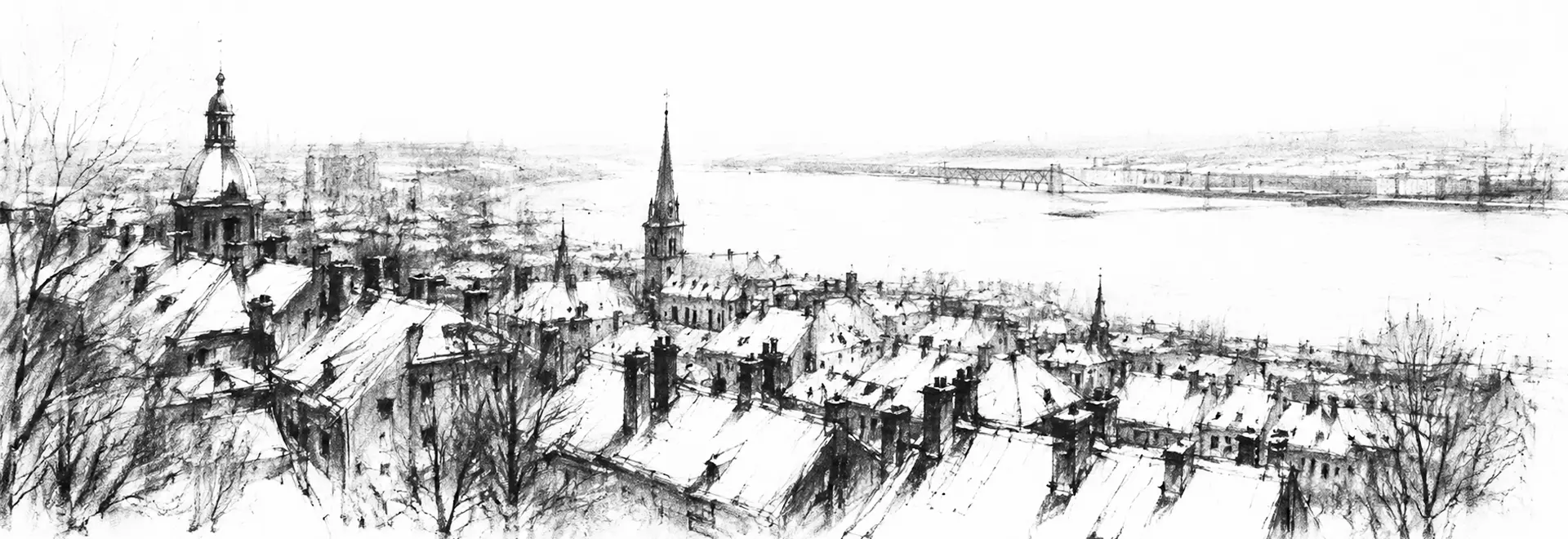
It came to me the way these places always do, in instalments, none of them mine. A documentary on a Sunday with the sound kept low, the camera walking down a cobbled lane between fur shops and grey stone. A double-page spread in a travel magazine in some waiting room — the old town from above, all slate and chimney, the river beyond. The flat encyclopedia entry I have had since school, three columns and one small photograph of a church I could not have placed on any map. And, later, other people’s holiday pictures, the ones that come back overexposed and slightly disappointed, as if the place had refused to be as good as the trip. Out of those leftovers I built a whole city, and then, quietly, moved into it.
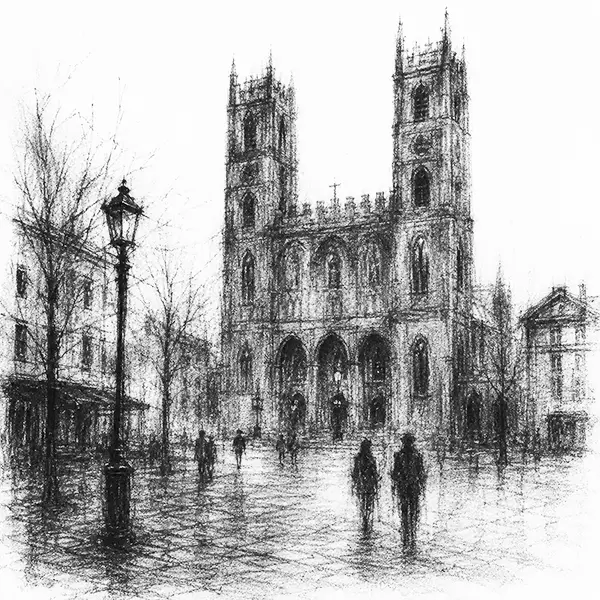
The oldest part is the part I keep best. A grid of stone laid down by people who had come a very long way to be cold, and who built, in their homesickness, the closest thing to home they could manage out of the local rock. Grey churches with green spires. A square of worn cobble that holds the wet the way old stone does. And over it the great dark basilica, two square towers and a front like a cliff, the kind of building put up by a settlement that wanted to prove to itself it was a real place and not merely an outpost. I have never stood in the square. I know exactly how the cold comes up through the stones into the soles of your shoes. I have decided I know it, which by now amounts to the same thing.
Two languages at once
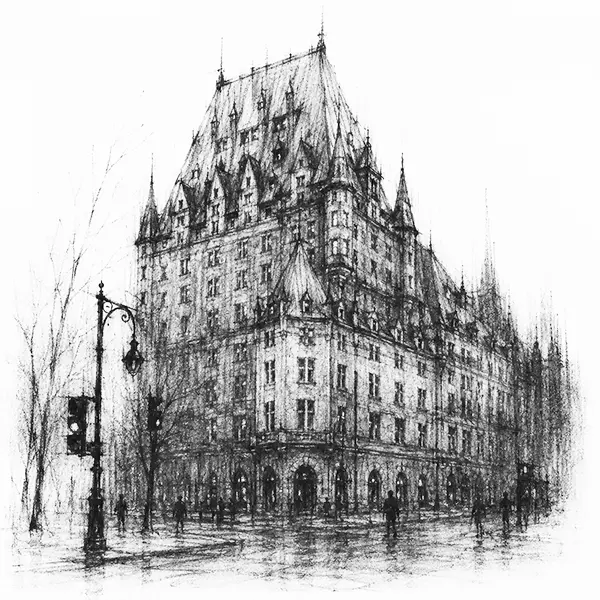
What I have, mostly, is the list. That the whole island lives in two languages at once and has fought, with real heat, over which one goes first on the shop signs — a city where the size of a word can become a matter of law, where you can be served, corrected and forgiven all in the space of one sentence that changes language halfway through. That the grandest buildings wear those steep green-copper roofs, châteaux dropped beside the railway as if a French king had ordered a hotel by post and got the address slightly wrong. That below the frozen streets there is a second city, an underground one, miles of warm lit corridor where in the worst of winter you can live, shop and go to work without once putting on a coat. None of these will ever be tested by me. I file them anyway, against a journey I keep meaning to make.
Staircases hung in the freezing air
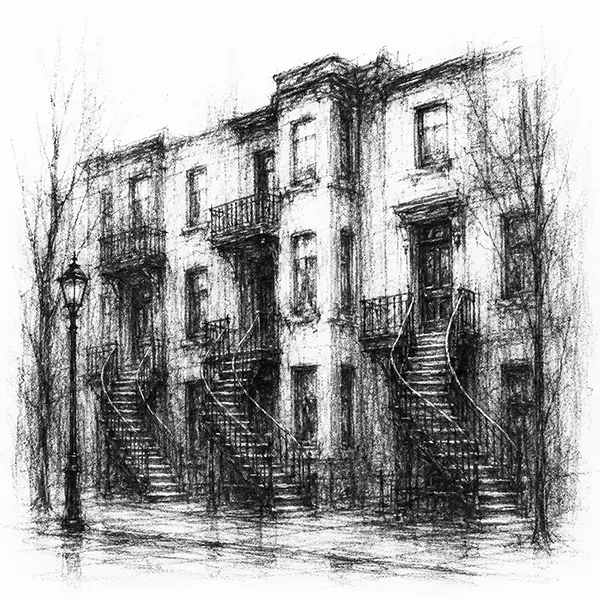
The detail I love most is the staircases. Row on row of brick houses three flats high, and bolted to the front of each one an iron stair that curls up the outside of the building to the upper doors — a spiral, sometimes, tight as a watch-spring, hung out in the open air. Someone explained to me once, with the confidence of a man who had read it somewhere, that they were built outside to save the warm space within, and that it is a small civic miracle nobody has frozen to death descending one in February. I think about those stairs more than is reasonable. A place that hangs its staircases out in the coldest air it owns, and then climbs them anyway, twice a day, all winter, because that is simply where the stairs are. There is a whole philosophy in it that I have not finished unpacking.
The oratory above the city
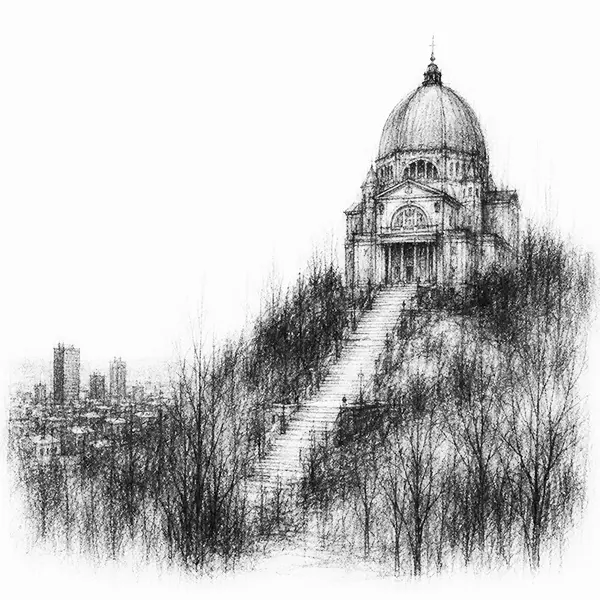
The mountain is the other thing. Not much of a mountain — a wooded hump in the middle of the island, the high ground the city was named for and then built carefully around, leaving the top as a great cold park you can walk up into and look down on everything you were just standing in. On its slope, though, someone raised a church the size of an argument: a vast domed oratory set into the hill, a green-black dome the encyclopedia insists is among the largest of its kind anywhere, with a long flight of stone steps running straight up to its doors that the devout are said to climb on their knees, one at a time, in the cold. I have seen it only in photographs taken from below, a pale dome floating over the bare trees with the whole city laid out small beneath it. A town that answers a hill by building something even higher on it, and then goes up the last of the way on its knees, is a town I would like to have understood before it understood me.
Montreal, the morning after snow
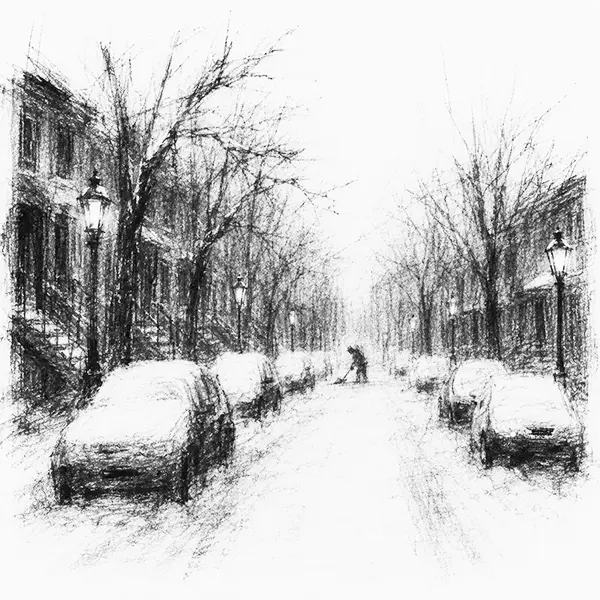
But it is the winter I return to, being a man from Calcutta, where cold is a rumour that arrives for three weeks in a borrowed sweater and leaves apologising. The footage I cannot stop watching is the plainest: a residential street the morning after snow, the parked cars rounded off into soft white loaves, the bare trees furred along every branch, a single person somewhere down the block bent over a shovel, and the particular hush a place falls into when the snow has taken the edges off the world. I have lived my whole life in heat. The idea of a cold so total that it organises the calendar, that decides what you wear and where you walk and which staircase you trust — it frightens and attracts me in exactly equal measure, which is, I have noticed, the formula for most of the places I keep.
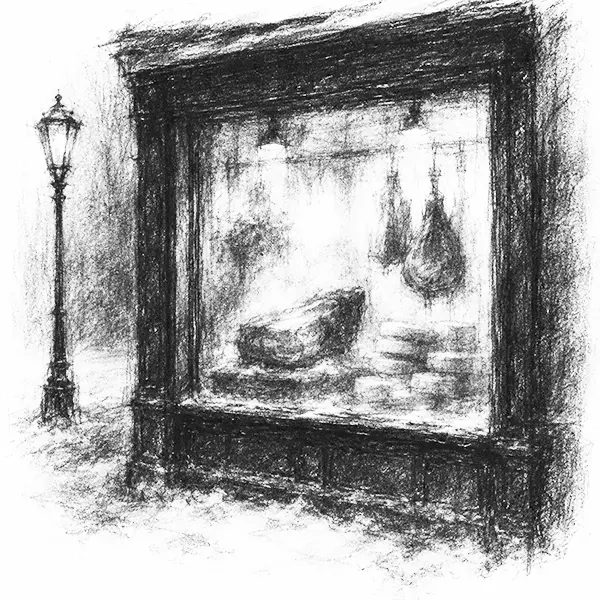
The most useful Montreal I own came from a former colleague, a restless sort who had spent a winter there years ago and remembered almost nothing of the sights. What he remembered was a counter, late, after the cold had got into his bones — a narrow steamed-up delicatessen where a man carved smoked meat by hand into a sandwich the size of a fist, and somewhere nearby an oven turned out small dense rings of bread that he swore, with a vehemence I have never forgotten, were the only ones worth eating on the continent. He could not tell me the street. He could tell me the warmth of the window from the outside, and the way the glass wept with steam, and that he had stood in the snow a moment before going in, just to look. That has done more for my idea of the place than every fact I have filed.
Here is the part I do not say at dinner. I could go. The passport is in the drawer, on its third renewal, clean as the day it was issued, and Montreal is a long flight and a stamped form and a sum of money I keep deciding to spend nearer home. No wall, no war, no one forbidding it — only the distance, and the visa, and the old reliable failure dressed each year in a new excuse. I have started to suspect I keep some of these cities precisely because I have not gone; that arrival is a kind of spending, and that the afternoon I finally stood in the real cobbled square in the real cold, my Montreal — the misfiled one, the European city marooned in the snow — would fold itself up and be replaced by the ordinary one everybody already has.
So I keep it where it is, up on its mountain under the great pale dome, the staircases hung out in the freezing air and climbed all the same, the steam on the deli window and the river going hard and white below. I have never been abroad; Montreal is one of the cities I have kept that way on purpose, filed under the wrong continent, in a hand I recognise as my own.
“Montreal: city of Quebec, Canada, on an island in the St Lawrence River; the largest French-speaking city outside France.”
— from a set of travel books once sold to the house, door to door

Leave a Reply