Abroad · never been
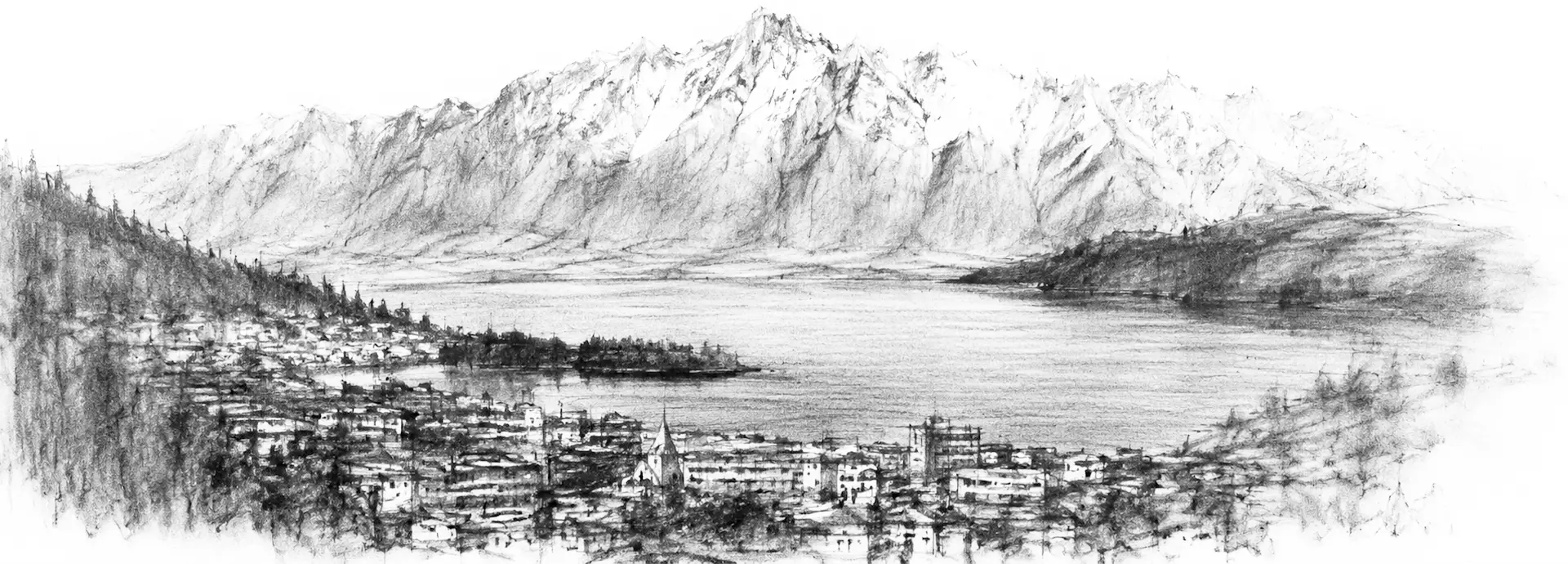
Queenstown is the town they built for people who cannot sit still, which is the first thing about it I have never been able to account for, since I have made a whole life out of sitting very still indeed. Everything I have gathered points one way: a small place near the bottom of the world, dropped between a long cold lake and a wall of bare mountains, where people go to be frightened on purpose — to fall off bridges on a rope, to be flung down rivers in a boat, to step out of an aeroplane over the whole arrangement and drop through it. A town organised, from end to end, around the half-second before you jump. I have never jumped at anything in my life. I have owned Queenstown for years without going, which is the longest hesitation I know of.
Queenstown from the gondola
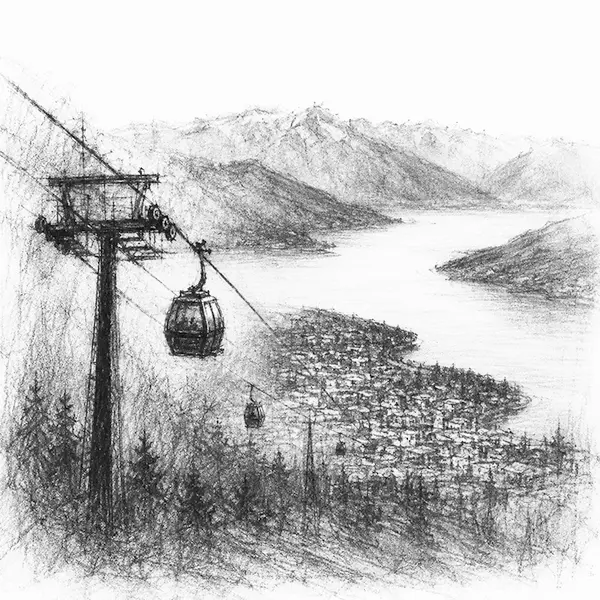
The first thing anyone shows you is the view from above. There is a cable car — a gondola they run up the steep face of the hill behind the town, near vertical in places — and from the deck at the top the whole of it lies out beneath you: the small grid of the town at the water’s edge, the lake going out long and grey-blue past it, and across the water the mountains they call, with a flat honesty I have always admired, the Remarkables, because somebody once decided they were and the name simply held. I have ridden that cable car a great many times, in the only way available to me, which is with my eyes and someone else’s photographs. From up there Queenstown looks like a thing you could pick up and hold in one hand. That is more or less how I have kept it.
The bridge where the falling began
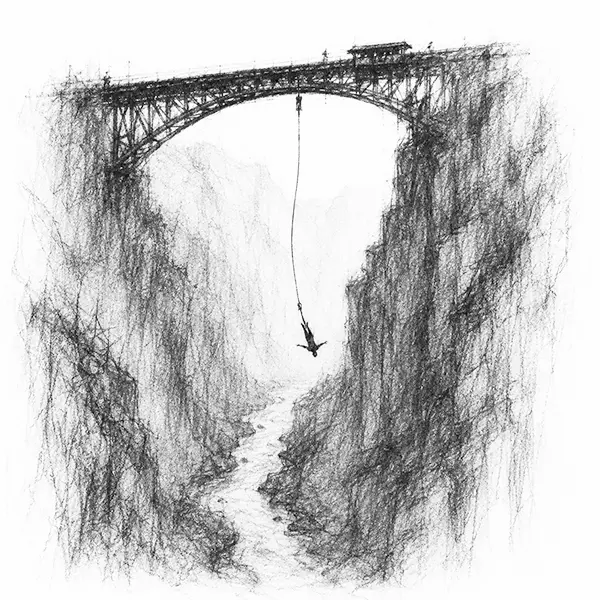
What made the place, though, was a bridge and a length of rope. I know — the way you know a fact that has been handed round so often it has worn smooth — that this was the first spot on earth where a man thought to string a cord from an old bridge over a green river gorge and sell you the chance to leap off it head first, and that people came, and kept coming, until a whole economy of engineered fear had grown up around that single idea. There is footage I have watched more often than I will admit to: a figure standing on the lip of the platform, arms out, the river turning far below, and then the small terrible decision to lean forward into nothing at all. I have never once understood the appetite for it. I have understood, completely, the standing on the edge and the not yet having gone. That part of it I could teach.
A boat built to run on spray
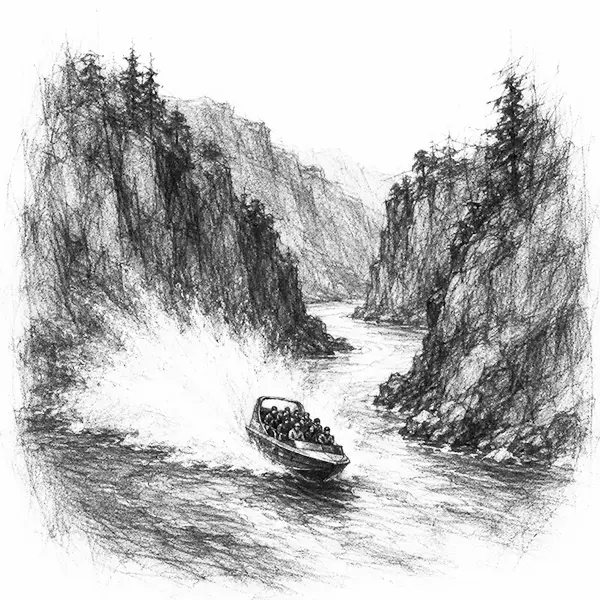
Then the boats. Somebody in this country worked out, decades ago, how to drive a boat on almost no water at all — to send it screaming up a shallow braided river between rock walls close enough to touch, and, at the end of a straight, spin the whole thing round in its own length in a fan of white spray while the passengers shout. I have seen the photographs many times: the boat thrown sideways, the sheet of water hanging in the air behind it, every face aboard wide open. A machine built to carry you as near the rock as terror will bear and then, at the last, not touch it. It is the same trick as the bridge and the rope, I think — the whole of the pleasure living in the margin, the narrow gap between the thing and the disaster, and I have spent my life keeping that particular gap as wide as it will go.
The old steamer on the lake at Queenstown
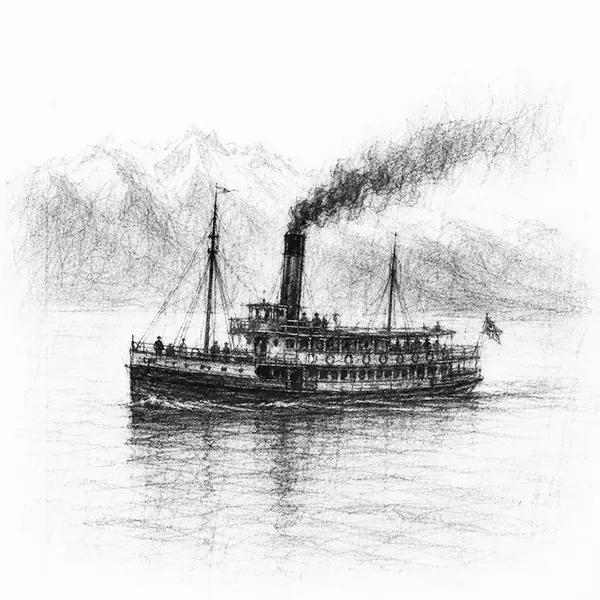
Not all of it is falling and spray. Out on the lake — Wakatipu, a long cold lake bent twice like a slack rope, and very deep — there is still an old coal-fired steamer that has crossed the water for more than a hundred years, its coal shovelled in by hand, trailing a plume of dark smoke across all that clean air like a sentence carried over from an older paragraph. I like it more than any of the fast things. A slow black steamer going nowhere in particular across a lake ringed with snow, while behind it the town sells the future by the half-hour. Somewhere in the gap between that steamer and that bungee rope is the exact thing about the place I keep coming back to and have never quite been able to name.
Gold along the water in autumn
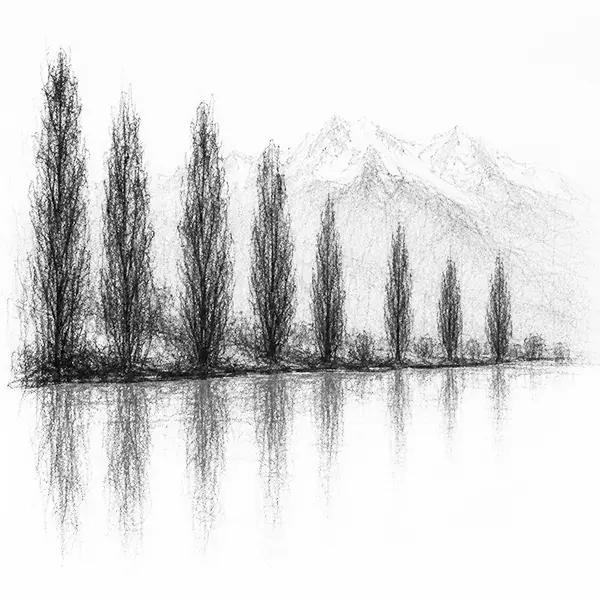
And there is a season for it. For a few weeks each autumn, the encyclopedia and the photographs agree, the tall poplars the settlers planted along the shore turn a gold so complete it looks arranged, doubled exactly in the still lake beneath them, the bare mountains white above, the whole valley for a short while got up in three colours and no more. Being a man from a city with essentially one long wet green season and one long dry brown one, I find the idea of a place that changes its entire palette four times a year, on a schedule, faintly unbelievable — a landscape that performs, and knows it. I have wanted to stand among those gold trees at the cold edge of that lake for longer than is at all sensible.
What Queenstown holds still
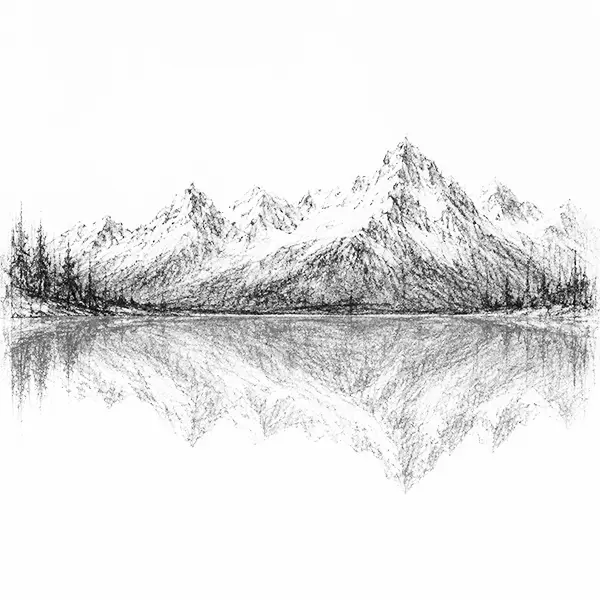
But the picture I keep above the others is the stillest one, which in a town like that is nearly a joke. Early, before the boats and the ropes are awake, the lake goes flat as a laid sheet, and the mountains stand in it upside down so cleanly you cannot at first tell the real range from the drowned one — the peaks above and the peaks below meeting at a grey line you could mistake for the edge of the world. A whole town given over to motion, built at the foot of the most motionless thing I have ever seen. I have looked at that reflection in a dozen strangers’ photographs, and each time it has done the same thing to me: made me want to go, and made me obscurely glad that I have kept it a photograph.
I could go. You have had this admission from me before and you will have it again. The passport is in the drawer, on its third renewal, clean as the day it was issued, and Queenstown is a long flight and a stamped visa and a sum of money I keep spending, year after year, on nearer and smaller things. No wall, no war, no one forbidding it but me. And still I have not gone, and the not-going has slowly turned from a failure into something more like a possession — a town I own outright precisely because I have never once signed for it.
So I keep it where it is, at the still hour before the ropes wake: the gondola hanging on its wire, the black steamer laying its smoke across the cold, the gold trees standing in the flat lake beside the drowned white mountains, and somewhere a figure out on a platform, leaning over a green river and not, in my version, ever quite letting go. I have never been abroad; Queenstown is one of the towns I have decided, for now, to keep on the near side of the jump.
“Lake Wakatipu: a lake of the South Island of New Zealand, about 80 km long and shaped like a reversed S; its surface rises and falls some centimetres roughly every half-hour, a motion older accounts explained as the slow heartbeat of a giant asleep beneath the water.”
— from a gazetteer, in the pages given over to the far side of the world

Leave a Reply