Abroad · never been
I grew up watching Berlin on the news, a city cut clean in half within living memory. A wall ran straight through the middle of it, through streets and squares and people’s lives, so that for the better part of my own lifetime the two halves could not so much as wave to each other. Then, almost overnight, it was stitched back together, the wall pulled down by hand, the city left to grow over its own scar in the open. It is not near me; nothing in Europe is. Getting there means a long flight, a visa to queue for, a fare I keep spending closer to home. That is what abroad is to a man with my passport. Of all the far cities I carry, this is the one I actually watched happen.
What pulls me is that the city did not tidy the wound away. I had expected, before I knew better, that a place with a history so heavy and so recent would shut it all up in a museum, hush it, charge admission. Instead, from everything I can gather, Berlin left a good deal of it lying about in plain sight — a line in the pavement where the wall ran, a surviving stretch left standing on purpose, the bullet-marks kept on an old façade, the rebuilt next to the never-quite-repaired. A city that decided the honest thing was to keep the scar showing rather than smooth it over. I respect that more than I can easily say. I come from a part of the world that is also stitched together out of a hard division, and that has chosen mostly to look away from it.
I have the place the way I have all of them — documentaries above all, the long grey films about the wall and the years either side of it, the encyclopedia, photographs, the newsreels of the night it came down that anyone my age saw and did not forget. Between them they have built me a city that is not pretty in the way the others are, and does not try to be: wide and grey and green, blunt rebuilt blocks beside survivors, a town forever digging itself up and arguing with its own past. I have never stood at the line where it was once divided. I think I would feel it in my feet.
The Berlin Wall, turned to a canvas
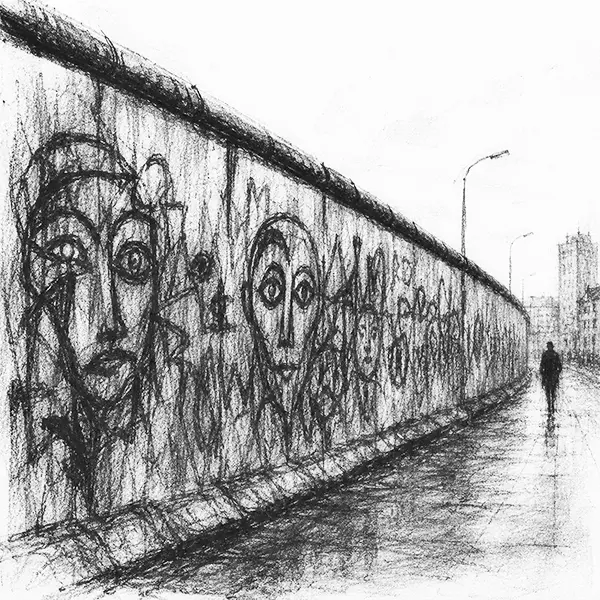
The thing I would go to first is a surviving piece of the wall itself — one of the stretches left standing on purpose, a long run of plain concrete now painted end to end in colour and faces and slogans, kept not as a monument to the thing it was but as something the city talks back to. A barrier turned into a canvas, the ugliest object a town ever built turned over to anyone with a spray can and something to say. I find that the right way round, the only bearable way round. I would walk the length of it slowly, reading the painted wall the way you read a long argument, and try to take in that this dull grey concrete once decided, absolutely, which side of a life you were born onto.
The gate that led from nowhere to nowhere
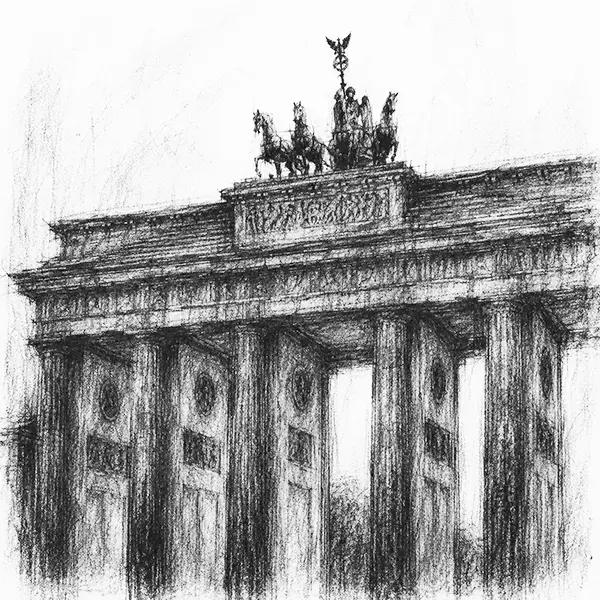
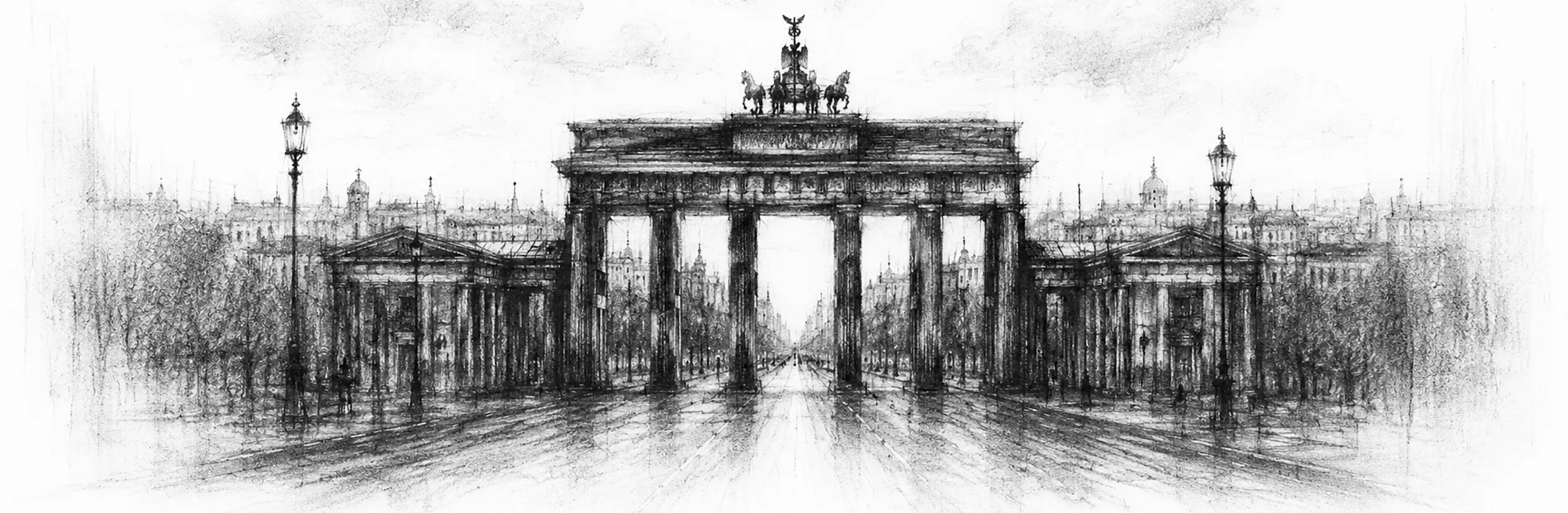
At the head of the great boulevard, the old columned gate — a row of tall stone columns crowned with a chariot, the city’s oldest grand front door, which for years stood marooned in the dead strip between the two halves, a gate that led from nowhere to nowhere, that no one could walk through. Now the traffic and the crowds pour under it again as if it had never been otherwise. I am moved by an object that has been on both sides of a city’s worst time — that was a symbol of triumph, then a symbol of division, then simply a place where people meet a friend. I would stand under it in the crowd and think about the years it spent with no one allowed to pass.
A clear dome, nothing to hide
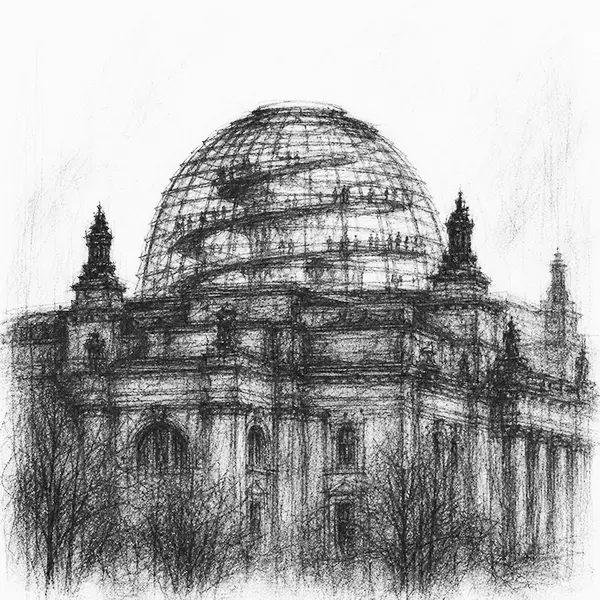
On the old parliament building they did something I keep turning over — they put a great dome of glass on top of it, a clear spiral you can walk up, so that the public stands literally above its own government, looking down into the chamber through the floor. A heavy stone building with its hard history, finished off with a transparent crown that says, more or less, nothing to hide now. I like a piece of architecture that is also a sentence, a building that has learned its lesson out loud. I would climb the inside of that glass and look down, and out over the grey city, and think about how much it must cost a place to earn the right to be seen through.
Finding your way by the old tower
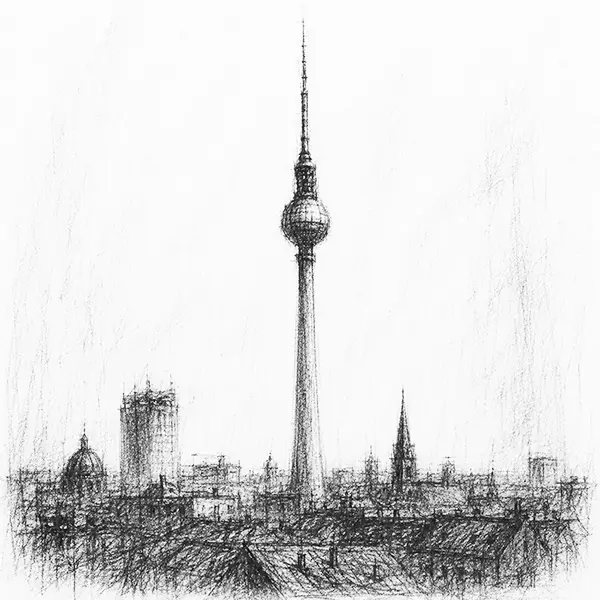
And over the whole eastern half, the television tower — a tall thin needle of concrete with a faceted ball near its top, built by the old eastern state to be seen for miles, and now just the thing everyone uses to find their way home, the city’s tallest landmark left over from the side that lost. I am oddly fond of these inherited objects, the monuments a vanished government built to impress that outlive it and settle quietly into being ordinary. It was meant to say one thing and now says another, or says nothing, just stands there being tall. I would use it the way the locals do, to work out which direction I was facing, and let its old meaning go.
The older, calmer Berlin
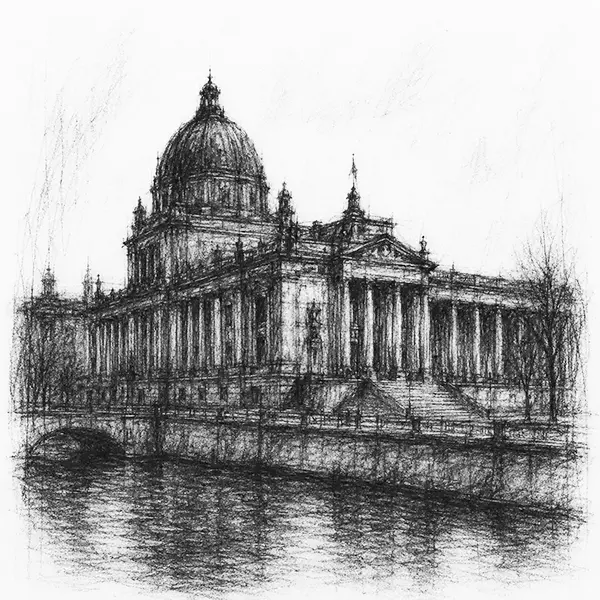
In the middle of the river that runs through it, an island of grand old museums — domes and long colonnades and broad steps, a whole little district given over to keeping things, standing on its own slip of land in the water. After all the rawness and the recent history, a reminder that the city is also very old, and was a serious place for serious things long before the century that nearly broke it. I am drawn to that contrast, the deep past and the raw recent one a short walk apart, the colonnades and the concrete in the same town. I would cross one of the bridges onto that island in the late afternoon and let the older, calmer Berlin have me for an hour.
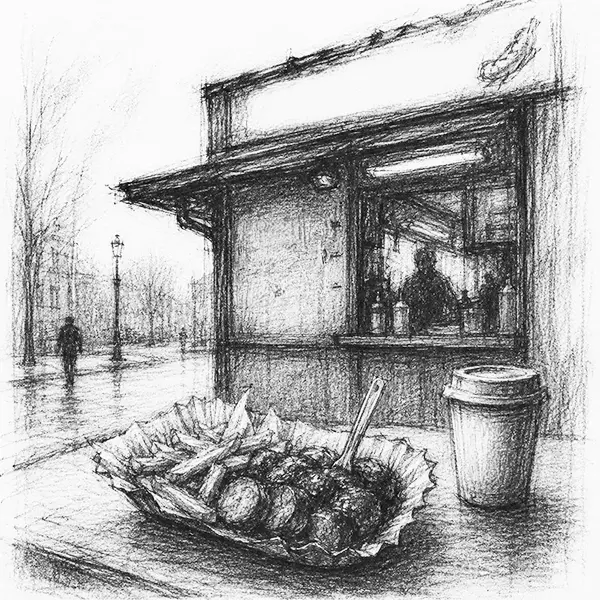
And, because the plain things always get me in the end, the street stand on a corner selling the city’s own no-nonsense snack — a sausage cut up and dressed with a curried tomato sauce, a dab of mustard, a paper tray of chips, eaten standing up in the cold with a coffee, the food of a working city that has never pretended otherwise. There is nothing refined about it and that is exactly the appeal. After all the weight of the history, the idea of standing at a metal counter in a grey square eating something cheap and hot and honest, watching an ordinary afternoon go by in a city that has earned its ordinary afternoons, seems to me close to the whole point of going.
So Berlin takes its place among the far cities — not pretty, not easy, not near, and the one whose great moment I actually remember watching. There is no good reason I have never gone, only the usual ones: the long flight, the visa, the fare always wanted nearer home, the steady habit of meaning to and not. It is a city that kept its scar in the open and built a clear dome over its government and let anyone paint the wall, and I have admired all of that from the far side of the world for most of my life without once standing in the cold square to see it. One of these years I should make the long way north and walk the painted length of the wall, and stand under the gate that led from nowhere to nowhere, and feel, in my own feet, the line where a city was once torn in two. I have never been abroad, and the one wall I most wanted to stand at fell before I had gone anywhere.
“Berlin: capital of Germany, on the river Spree; divided after the Second World War by a wall between its eastern and western halves until 1989, and since reunified; known for its gate, its museums, and the surviving traces of its division.”
— from a magazine cutting I have kept for no reason I can name

Leave a Reply