Abroad · never been
I have wanted, for a good many years, to stand once inside the largest crowd human beings have ever assembled — which is Tokyo, thirty-seven million people by the encyclopedia’s count — and find out what it does to a man who learned crowds somewhere else. Because I know crowds. I was raised on the outskirts of Calcutta and spent thirteen years in Delhi and Gurgaon; my crowds press, lean, talk, take your elbow, breathe on your neck, pass you through a railway station like a parcel. The crowd in Tokyo, every documentary insists, does none of this. It is enormous and it is silent and it does not touch. I have been turning that over for most of my adult life, and I cannot settle it from here: whether such a crowd is a kind of paradise or a kind of warning.
Tokyo’s crossing, four times a minute
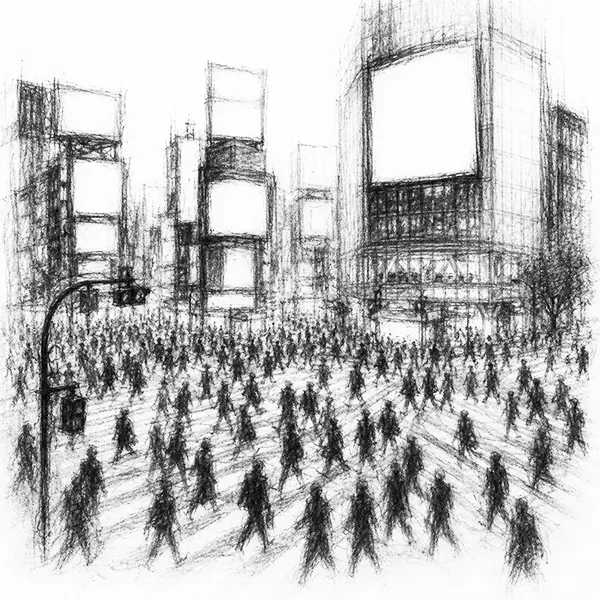
The crossing is where the whole idea concentrates. A documentary, years ago, the sound turned low: an intersection in the middle of the city where the lights on every side go red at the same moment, the traffic stops, and the people — up to three thousand at a single change, the footage claims — step off all the kerbs at once and pour straight through one another in every direction. Nobody slows. Nobody touches. Then the lights change and it is a road again, as if nothing had happened, and inside the minute it happens again. I have watched that thirty-second miracle more times than I will admit. Where I come from, a crossing is a negotiation: horns, hands, eye contact, a shared decision to survive the next ten metres together. Here, thousands of private errands pass clean through each other without acknowledging one another exists, and I cannot tell from the footage whether it is the loneliest thing I have ever seen or the least lonely. Not deciding is most of why I keep it.
The lantern the crowd pours under
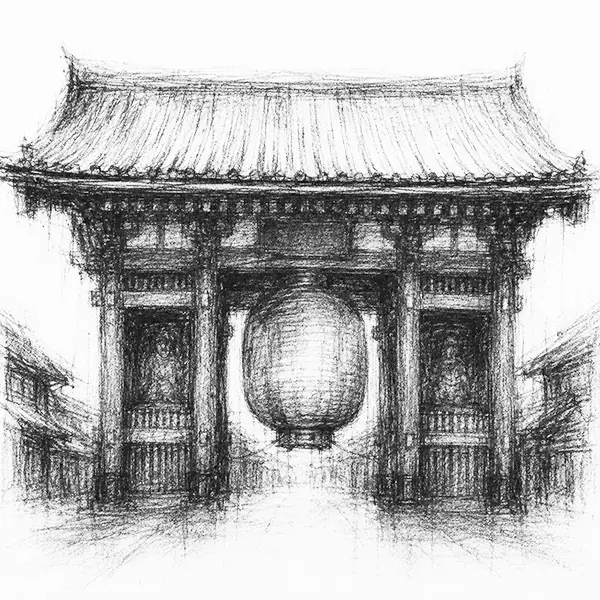
Against all that motion the magazines always set one still thing: a paper lantern the size of a small room, hung in the middle of an old temple gate in the low eastern part of the city. The temple is the city’s oldest — founded, the encyclopedia says, some thirteen centuries before anyone thought to build a screen the size of a house — and the crowd pours under the lantern all day at the same pitch as the crossing, except that here it slows. People stop at a great bronze cauldron of incense and wave the smoke over their own heads, for luck, for health, for whatever needs mending, and then rejoin the current. I like that the machine city keeps this in working order. Not preserved behind glass — used: the oldest door in Tokyo, still taking the crowd in.
The trains Tokyo runs to the second
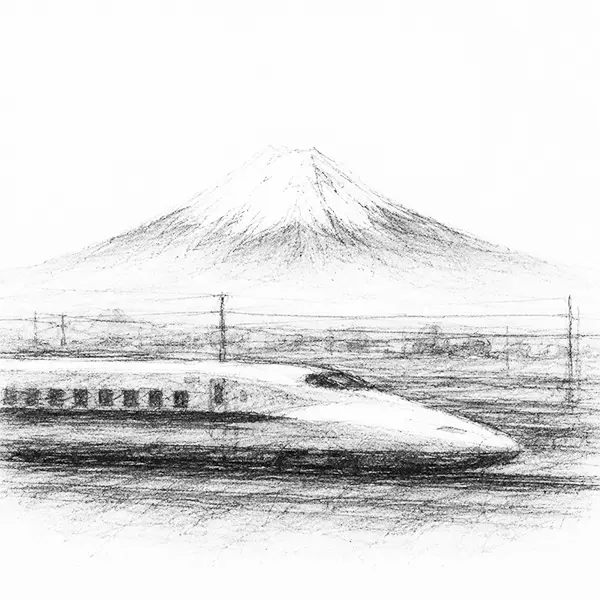
The trains are the part I take personally. I come from railway people — a whole country of them — and our trains are mighty, patient, and late. The fast white ones here, pointed like a held breath, post an average delay for the entire year that is measured in seconds. There is one photograph everybody has: the train streaking low and level across the foreground, half out of the frame already, and behind it, calm and enormous and going nowhere, the pale cone of Mount Fuji with the snow still on it. The fastest thing the crowd ever built, caught dead still in front of the slowest thing in the landscape. And at rush hour, the footage shows men in white gloves on the platforms, easing the last passengers gently into the carriage — the crowd packed so dense it must be finished by hand, and even then the touching is a job: gloved, official, apologised for. My crowds do that for each other all day, ungloved and unthanked. That is the one difference I keep coming back to.
Six stools and a counter
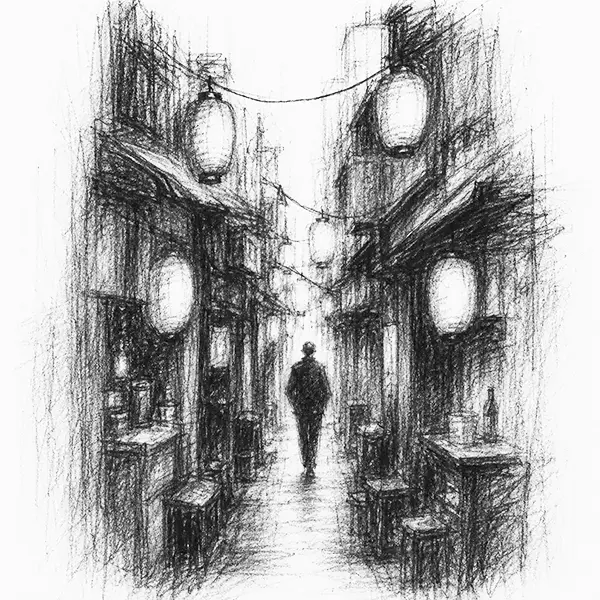
But the Tokyo I would actually want, if I let myself want, is small. The footage always finds them, in among the towers: lanes barely a person wide, strung overhead with little lanterns, lined with bars the size of a cupboard — six stools, one man behind a counter, room for nothing else. You duck in, a man I worked with in Gurgaon told me — he went once, for a conference, and skipped an afternoon of it — and within a sentence the owner knows whether you belong, and if you do, you are fed and poured for and entirely accounted for, one of six, in a city of tens of millions. I have kept his afternoon more carefully than most of my own. The largest crowd on earth hides, in its own gaps, the smallest rooms anyone lives in, and a person can be lost and found on the same street depending only on which door he chooses.
When the whole crowd sits down
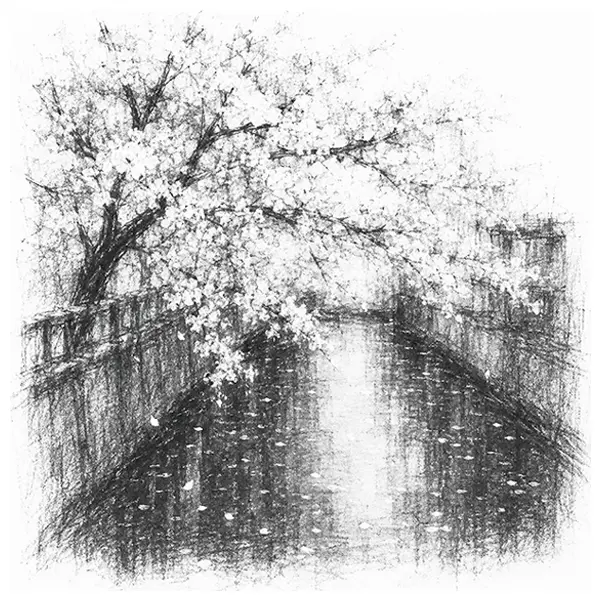
Once a year, the crowd stops. For a week or two the trees come out all at once in a pale foam of blossom, and the same city that crosses the road four times a minute goes out and sits under them on spread cloth and does, deliberately, nothing. Offices send a junior out at dawn to hold a good spot, shoes off at the edge of the sheet, asleep by ten. The photographs I keep are of a Tokyo canal with the blossom leaning right out over the dark water and the petals coming down onto it. A magazine writer once explained, a little pleased with the lesson, that the flower is loved precisely because it does not last. I do not need the lesson; I need the sitting-down — the most private crowd in the world spreading its cloth in public, all together, in the same week, by common unspoken consent.
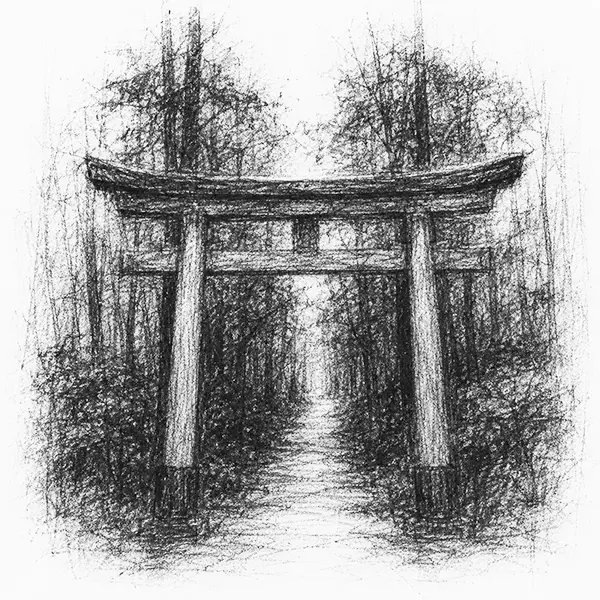
And when the crowd wants quiet, it walks into a forest it built itself. This is the fact that finally beat me: the great shrine wood in the middle of the city — tall, dim, ancient to look at — was planted by hand, a century ago, a hundred thousand trees sent as gifts from every corner of the country and set out by volunteers to a plan meant to take a hundred and fifty years to finish growing. A plain torii gate stands at the mouth of it, two uprights and a lifted crossbeam, and past it the traffic goes quiet and the instruction changes to nothing more than: pay attention differently now. A crowd of millions that wanted a silence and, finding none left standing, grew one. I have passed through plenty of doorways that changed nothing. I think about that gate more than is reasonable.
The light Tokyo leaves on
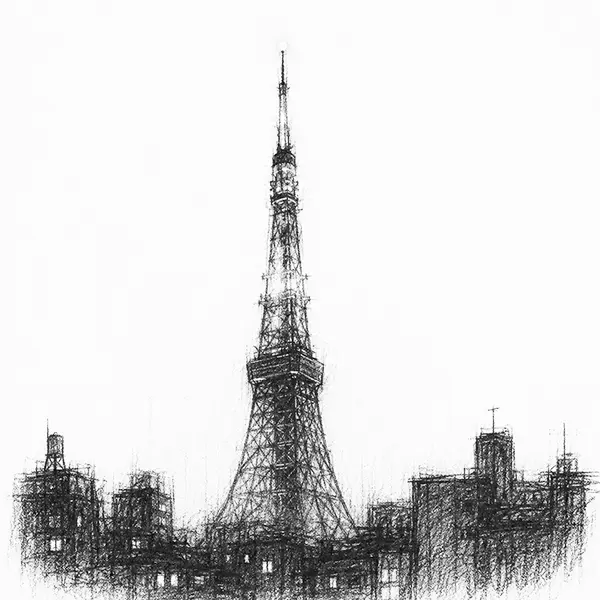
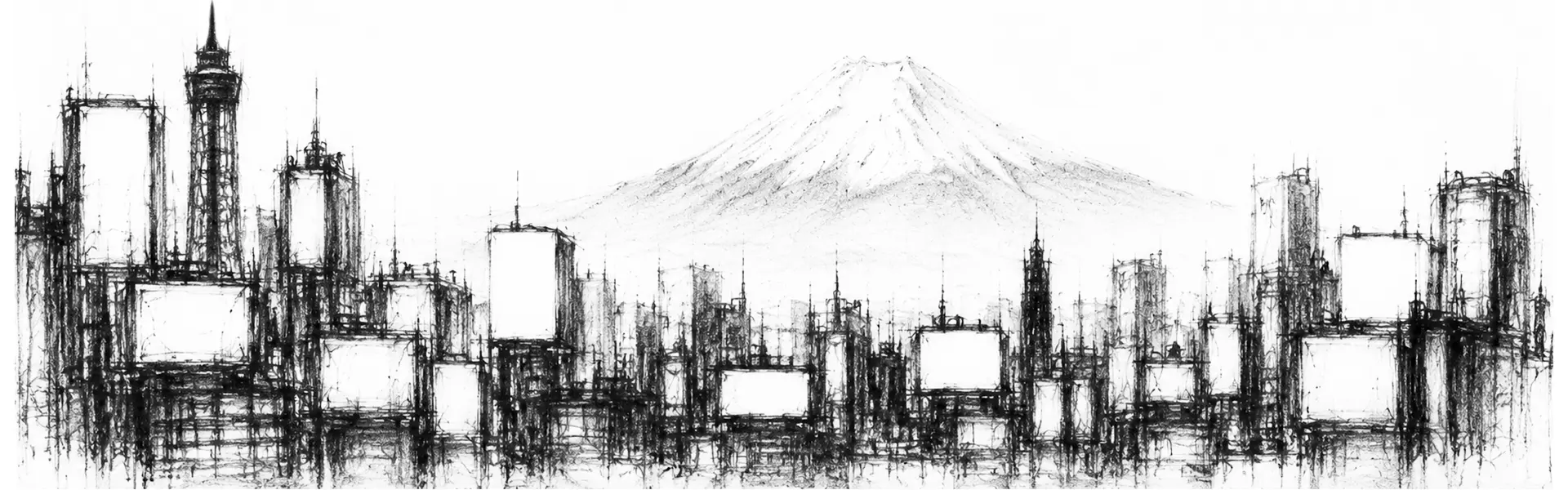
Over all of it, in half the pictures, stands the tower — the tall lattice thing they raised in the nineteen-fifties, when the city was climbing back onto its feet, a copy of a more famous tower in another country and, they will tell you, a few metres taller than the original, which is a detail I have always found very human. At night it is the last thing burning when the streets finally empty — which they apparently do, though I believe that the way I believe in other people’s tidy kitchens. A city of that size keeping one light on at the top, like a person who cannot quite bring himself to say the day is over. I recognise the gesture. I have kept a good many lights on myself, over things I meant to get to.
Could I go? Of course. Tokyo is a long flight and a visa and a fare I have spent, more than once, on nearer and duller things; the obstacle, as usual, has my own face. But what actually keeps me circling, I think, is that going would settle the question I have carried since that first documentary — paradise or warning — and I am not certain which answer I could stand to bring home. In my crowds, to be alone in the crush is a small failure; the crowd will not really allow it. In Tokyo, by every account, the aloneness is built in — load-bearing, worn without embarrassment by millions at once. A man raised to be handled by his cities might step into that and feel free for the first time in his life. Or he might just feel the cold.
So for now I leave Tokyo running exactly as the footage left it: the crossing filling and emptying inside the minute, the lantern taking the crowd in, the junior asleep on his spread cloth under the blossom, one light on at the top of the tower. It is a strange thing, missing a crowd of strangers on the far side of Asia — stranger still for a man who has never been abroad, and so has never once been touched, or left untouched, by any crowd but his own. I miss it anyway. Some rooms you can miss from the light under the door.
“Tokyo: capital of Japan, on the island of Honshu at the head of Tokyo Bay; the most populous metropolitan area in the world, on a plain overlooked to the west, in clear weather, by Mount Fuji.”
— from an old almanac, somewhere between the tide tables and the kings

Leave a Reply