Abroad · never been
Siem Reap is the town you fly into to see the largest temple ever built for a god — and the god, it always stops me to remember, is one of mine. Angkor Wat, a mile or two outside Siem Reap, was raised to Vishnu, out of the same crowd of gods and epics I was handed as a child in Bengal: the churning of the ocean, the monkey armies, the wheel of the sun. A Khmer king built it nine hundred years ago, on a scale nobody in India ever attempted for those stories, in a country I have never been to. That is the thing I keep turning over. The grandest monument my own inherited mythology ever received sits at the end of a flight I have not taken, and I have spent a lifetime meaning to go and stand in front of it and never quite gone.
Siem Reap wakes for something older than itself
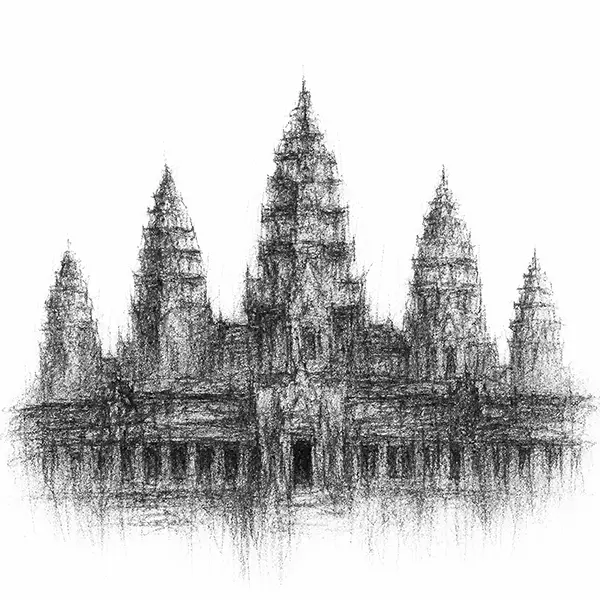
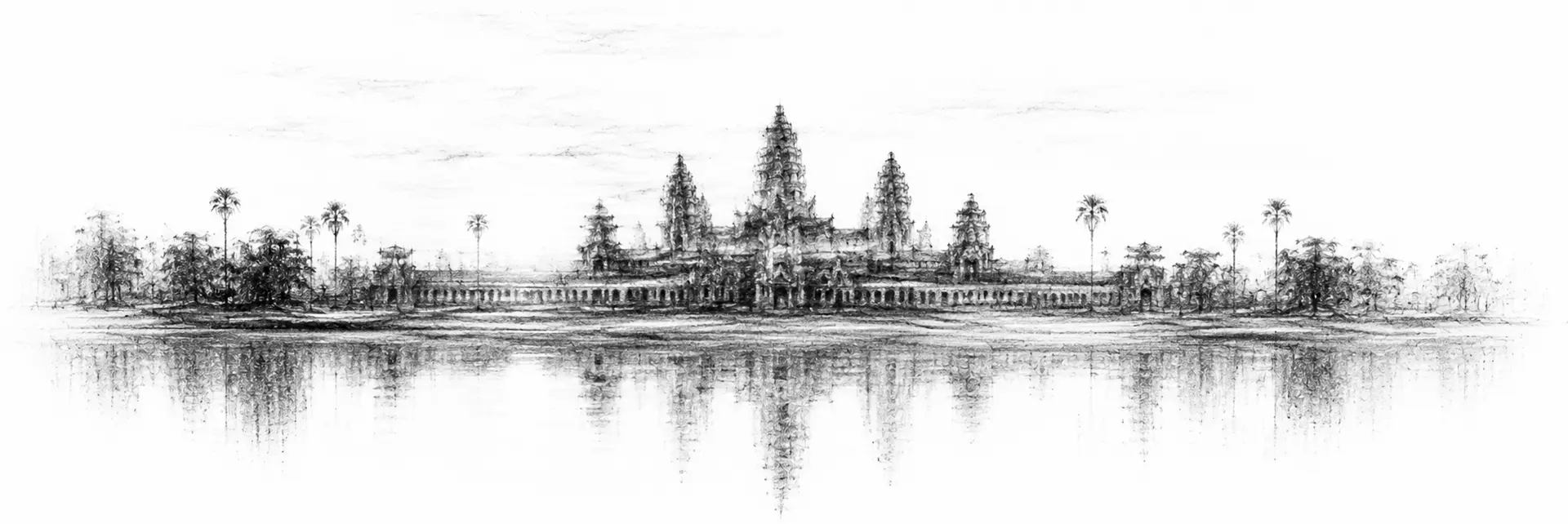
What everyone brings back is the sunrise, and I have received it so many times secondhand that I could stand in for a witness. You go out in the dark, the accounts agree, across a long stone causeway over a moat as wide as a river, and you wait in a crowd that has come the same distance you have and for the same reason, and then the sky behind the temple begins to go from black to the colour of a bruise to something you have no word for, and the five towers come up out of it one shade at a time. Five stone towers shaped like closed lotus buds, the tallest in the middle, arranged so that the whole thing reads at once as a mountain and a map of a sky nobody living remembers believing in. The photograph is on the country’s own flag, which I always find a strange and moving thing — a nation that put its oldest ruin on its newest banner, as if to say, whatever else has happened to us, we made this, and it is still standing, and you may look.
The faces that watch every direction at once
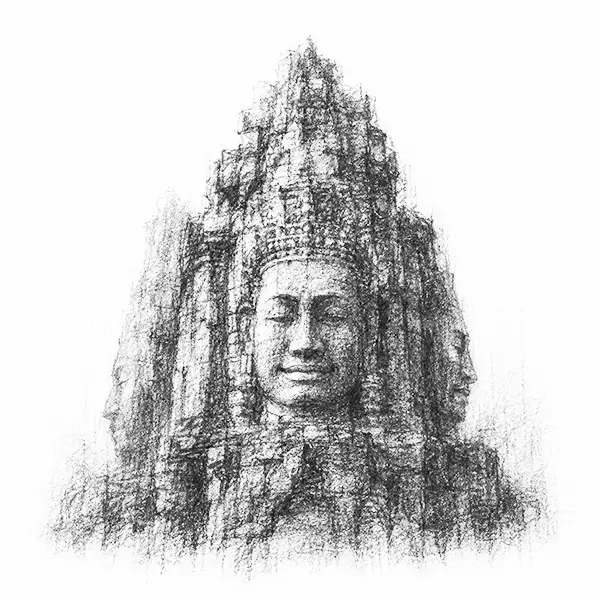
Deeper in there is a second temple I find harder to be calm about. The encyclopedia mentions, in its flat way, that it carries over two hundred enormous stone faces, carved on the four sides of its towers, all the same face, all smiling faintly, all looking out and slightly down. Who the face belongs to — a king, a god, or a king who had decided he was one — nobody quite agrees. There is footage of a person turning slowly in the middle of it, watched from every direction by the same serene expression dozens of times over. A ruler who arranged to be looked at forever, his own calm face cut two hundred times into the towers so that no one anywhere in the temple could ever be out of his sight. I keep meaning to be unsettled by that, and instead find it almost tender — the way vanity goes tender once everyone it was aimed at is a thousand years dead.
Where the forest took its stone back
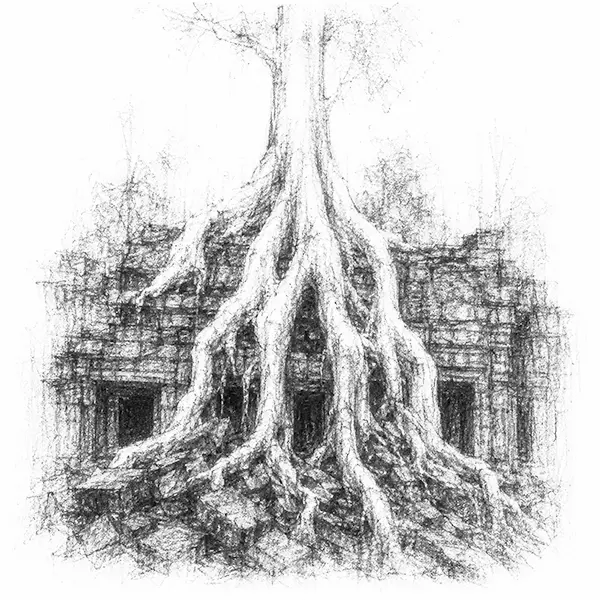
But the picture I cannot put down is the one where the forest won. There is a temple out among the Siem Reap ruins that they deliberately never fully cleared, and the photographs of it are the most reproduced of all: great pale trees standing straight up out of the ruin, their roots pouring down over the walls like slow water turned to wood, prising the blocks apart and holding them in place at the same time, so that you cannot any longer say whether the tree is destroying the temple or is the only thing keeping it standing. I have looked at that one until it stopped being about a temple. A city so completely lost that the jungle grew up through the middle of it and had to be found again centuries later, the roots by then part of the architecture, and no way to remove the one without bringing down the other. There is more of my own life in that image than I am comfortable writing down.
A robe against the grey stone
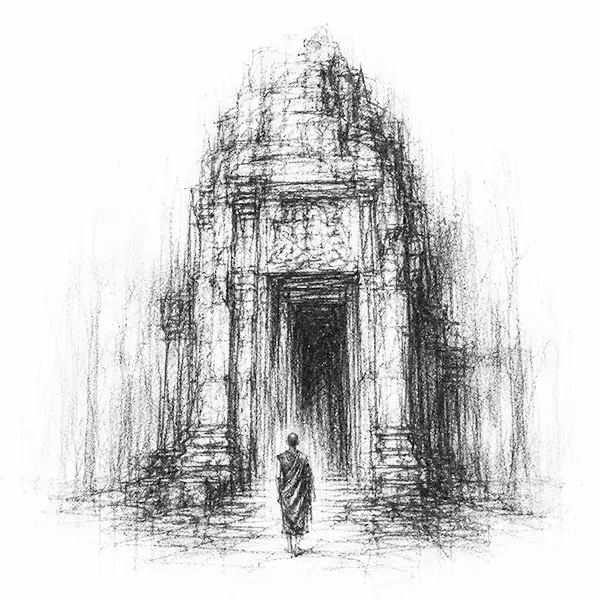
The one warm colour, in a place I otherwise hold entirely in greys, is the monks. In half the photographs there is one somewhere in the frame, a figure in a saffron robe standing small at the foot of some vast weathered doorway — the living faith walking through the dead one, the guidebooks are quick to say. I distrust how neat that is and keep it anyway, because underneath there is something true: the religion the Siem Reap temples were built for has mostly gone, replaced by a gentler one that arrived later, and the new faith simply moved into the old one’s house without knocking anything down. A person in a bright robe going about a Tuesday inside a monument raised to gods his own gods replaced, finding nothing strange in it. I would like to have watched that from a respectful distance, and understood how little it costs a place to change what it believes and keep the same walls.
The floating village beyond Siem Reap
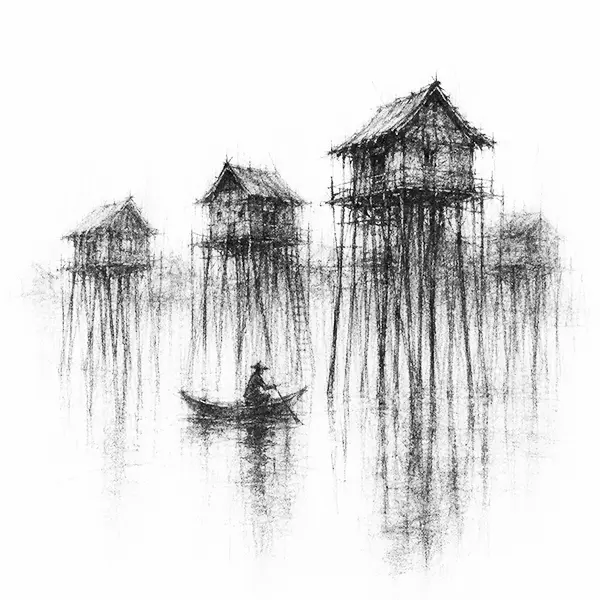
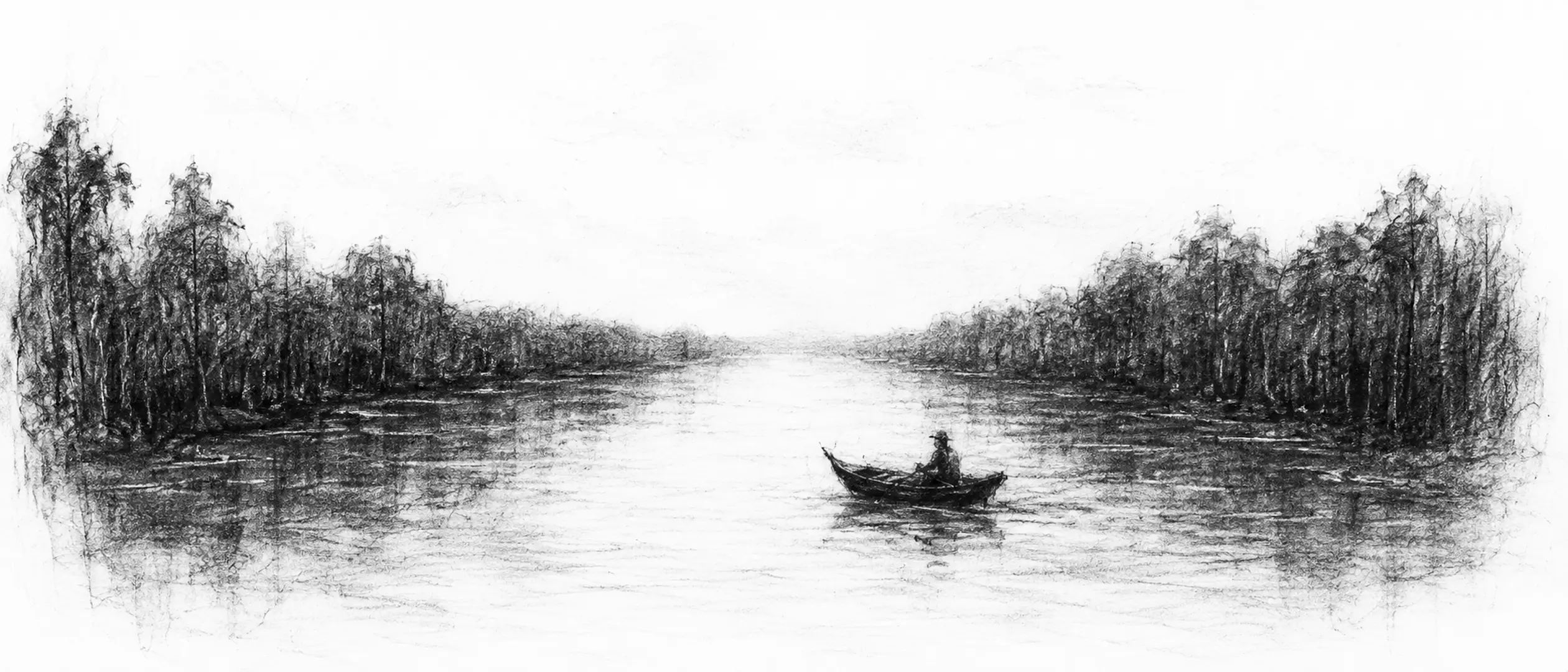
Past the Siem Reap temples the land goes flat and wet, and there is the lake. The largest in the region, the encyclopedia says, and a strange one: it breathes with the seasons, swelling to several times its size when the rains come and a great river reverses to feed it, then shrinking back when the water withdraws. People live on it in houses on stilts, whole villages standing up out of the flood on long poles, boats where a lane would be, a life arranged entirely around water that will not agree where its edge is. I keep it beside the temples as the other half of one idea. In one place people cut a mountain out of stone to hold still against time forever; a little way off, others built their homes on poles precisely so they could rise and fall with a lake that changes size every year. Two ways of answering the same water, and I have never decided which I would have chosen — probably why I keep them both.
My own gods, waiting at Siem Reap
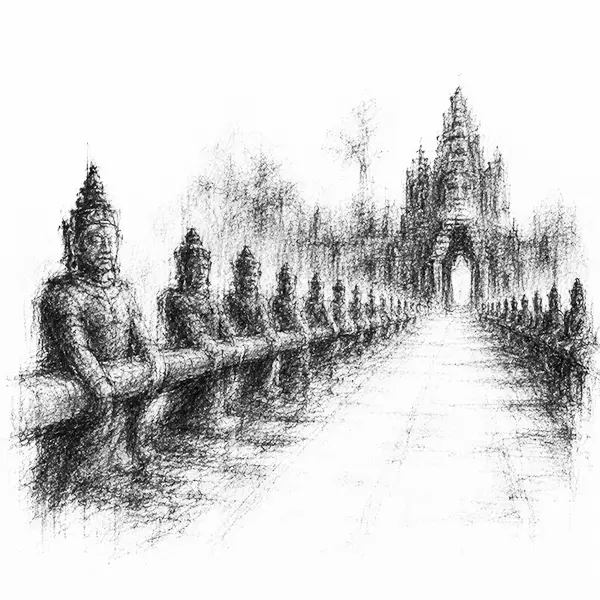
The image I keep for last is a kind of road. At the entrance to the great walled city beyond the temples, a stone causeway crosses the moat lined on either side by a long row of carved figures, each row gripping the body of an enormous serpent and leaning back as if in a tug of war — gods down one side, demons down the other, hauling on the snake between them. It is a story I knew before I could read: the churning of the ocean, gods and demons pulling a great serpent coiled round a mountain to stir the sea until it gives up the nectar that makes them deathless. I was told it as a child in Bengal, out of the fat book of tales half the houses I knew owned. And here it is at Siem Reap, not told but built — laid out at the size of a bridge, in stone, by people who carried the story a thousand miles from where I first heard it and made it grander than anyone at home ever did. That is the one I cannot quite forgive myself. The oldest story I own, standing in a row at the end of a causeway in a country not mine, and I have never walked the causeway to reach it.
I could go. The confession is the same one I always end on. The passport is in the drawer, on its third renewal, unstamped, and Siem Reap is a long flight and a visa and a sum of money I keep spending, year after year, on things closer to hand. Nothing forbids it. The doorway has been open the whole time. And yet I have not walked out across the causeway in the dark to watch the towers come up out of the black water, and by now the not-going is not an accident I keep having but a decision I keep quietly making. I have begun to think I hold the temple exactly as the photographs handed it to me because if I went, the crowd and the heat and the ticket queue would fold themselves around it and hand me back the ordinary miracle everyone else has already been sold.
So I keep it where it is, in the last of the dark, just before the sky turns. The five towers are still doubled in the moat, the two hundred faces are looking out in every direction over an empty temple, the roots are holding up the wall they are pulling down, and out on the flat land the houses stand patiently on their poles, waiting for the water to decide. For a man who has never been abroad I have grown oddly loyal to a place I keep refusing to let become real — Siem Reap, where the oldest gods I own are standing in a row at the end of a causeway I have meant, one more year at a time, to walk.
“Angkor Wat: temple complex near Siem Reap, Cambodia, built in the 12th century; the largest religious monument in the world, and depicted on the national flag.”
— from a set of travel books once sold to the house, door to door

Leave a Reply